

In the waiting room, the wall is impressive: six frames, a parchment certificate, two gilded edges catching the light. You're in a robe, bare feet in cotton slippers, and there's really only one question worth turning over: who is going to put their hands on your face, and what did that person actually learn? It's not suspicion and it's not snobbery — it's the same reflex as glancing at the menu before you order.
The wall is decorated, but the name might be the owner's
A salon opened in 2004 by a beauty therapist who framed her diplomas and who now employs two younger colleagues: that is the most ordinary scenario there is. The wall tells the story of the house, not the story of the hands taking care of you. So read the name on the certificate. If it doesn't match the person greeting you, it isn't a scam, but it isn't information about her either.

And three metres away, under spa lighting, a gold frame won't help you tell a nationally recognised qualification from an end-of-course certificate. Both look lovely. One certifies skills that have been assessed; the other confirms that someone turned up to a course. Your face deserves to know the difference.
Diploma, regulated qualification, certificate: what each piece of paper says
There are three families, and they are not equivalent. On one side, nationally recognised beauty qualifications — the kind built around a syllabus, exams and compulsory work placements, and regulated by the relevant UK qualifications authority. On the other, qualifications accredited by a recognised awarding body, also built on a set framework and an assessment. Then there are the private-school certificates: some are listed on a public register of regulated qualifications; others remain in-house certificates with no outside check at all. Asking "Is it regulated, and who awards it?" isn't aggressive, it's precise.
That leaves the certificate of attendance, the one that proves attendance on a course, sometimes with no assessment whatsoever. The course may have been excellent; it says nothing about what that person can do alone the following day.
What paper can't tell you, though: the lightness of the touch, the ability to judge pressure on skin that flushes easily, the listening. A diploma doesn't make hands sensitive. What it can show is more basic — hygiene, product knowledge, spotting the situations where you don't touch at all — and that is already a great deal.
The question to ask, and when to ask it
On the phone, while you're booking, one sentence is enough: "What training did you do?" Then, straight after, the one that changes things: "Will you be doing my treatment?" In a salon with several rooms, the voice on the phone is not always the hand in the room.

In person, read the treatment menu as closely as the decor: a first name on the rota, a list that separates facials, body treatments and massages. And if the answer is "therapist", ask: "Therapist in what?" It's a lovely word that tells you nothing. For a massage with a therapeutic aim, check the practitioner's title and registration; a wellbeing rubdown is usually a salon matter. Not necessarily the same address, not necessarily the same framework. The letters after a name often count for more than the job title alone.
Three questions, thirty seconds, no inspector tone: which qualification or certificate, and who awards it? Are you the one carrying out my treatment? If it's a private-school certificate, is it listed on a public register of regulated qualifications?
Budget
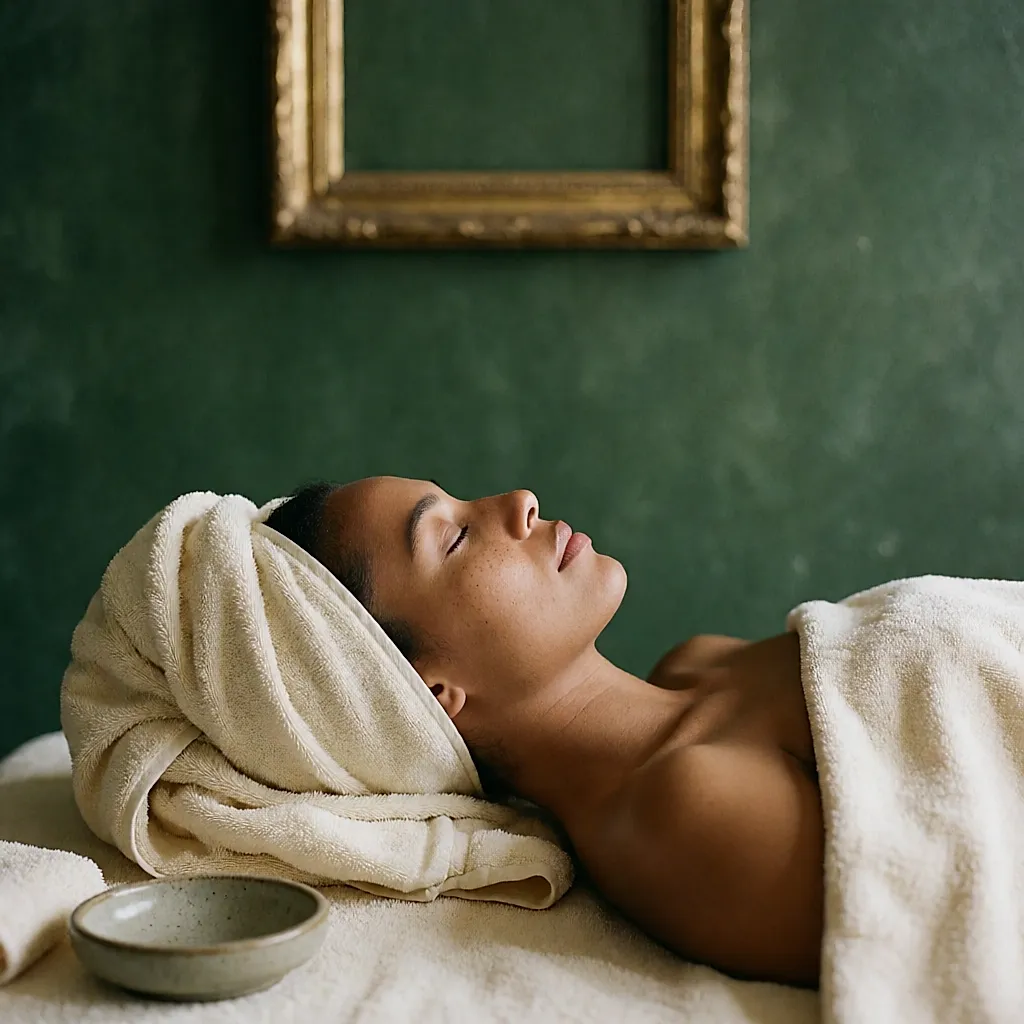
As a rough guide, a facial in a neighbourhood salon comes in at around £40 to £75, depending on the city, the length of the appointment and the product range — prices move, so check before you book. At a hotel spa or a central London address, the same treatment often climbs to £75–£135, and more again for "signature" packages. A body scrub or body treatment generally sits between £45 and £100, and three-session bundles bring the unit price down.
Where can you spend less without giving up on care? Training schools often offer cut-price treatments carried out by students under supervision — ask who is supervising. Salons in smaller towns, with lower overheads, also tend to be kinder on the card than a central London one. And hold on to this: an extra treatment suggested mid-appointment is not an obligation.
The wall isn't the thing treating you
A wall of certificates is useful decoration: it reassures, it tells the story of a house, it gives the eye something to do while you take your shoes off. It is no substitute for a question asked out loud. At your next appointment, give yourself thirty seconds of quiet digging — often the answer comes back proud and detailed, and that's a rather good sign.
And if the fog doesn't clear, you're allowed to postpone. A rescheduled appointment costs less than an hour spent gritting your teeth. The one move left when you've only got five minutes is to ask — the rest is done by hands.

Comments
Your opinion matters: rate the article, react and reply to comments.
Comments are moderated; AI-assisted comments are flagged. Text emoticons (8-), :-), <3…) are automatically shown as images.