
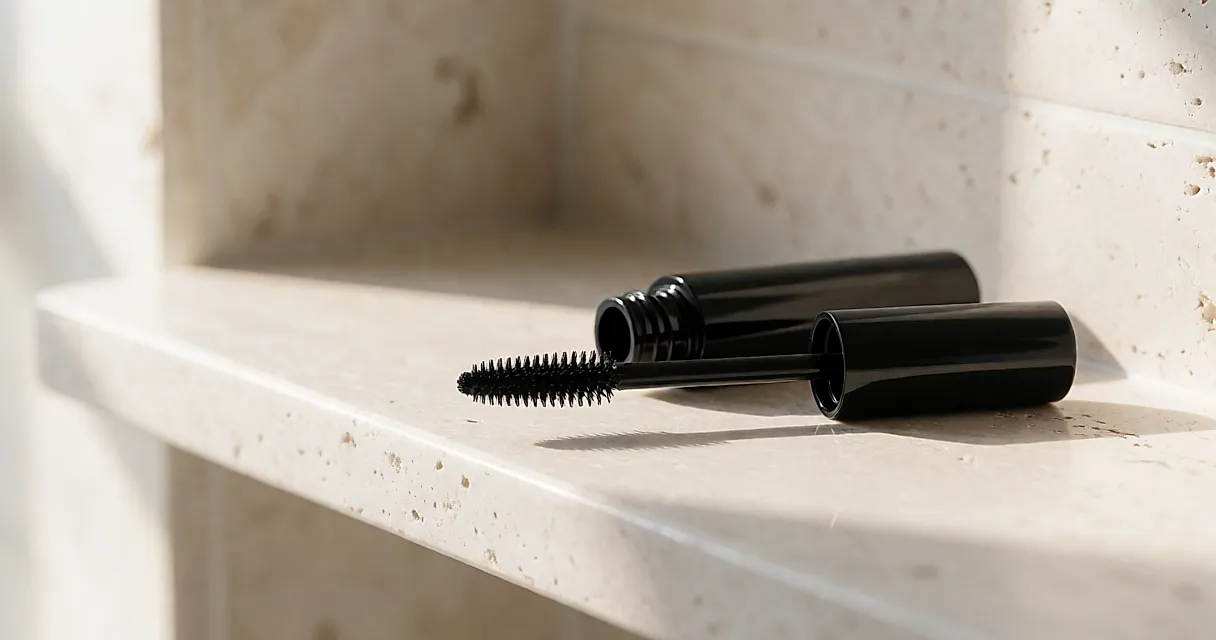
You've bought a mascara for its promise — "intense volume", "curl-boosting" — then spent ten minutes on a Monday morning prising apart two clumps of lashes that had turned into cocktail sticks? The tube ended up at the back of the drawer, and the formula was rarely to blame. The culprit is the small black object you didn't even glance at on the shelf: the wand.
Its shape dictates the stroke, the stroke dictates the result, and the formula comes after. Reverse the order you shop in, and it all gets clearer.
The real conductor is at the end of the stem
A wand is fibres — natural or synthetic — fixed to a stem, packed more or less tightly, longer or shorter, softer or stiffer. All of that decides how much product lands on the lash and how it spreads. Why does one new tube work wonders while another, bought the same day, produces clumps? Usually it comes down to the density of the brush head. A dense wand loads a lot; an open, airy one separates. Not magic — mechanics.
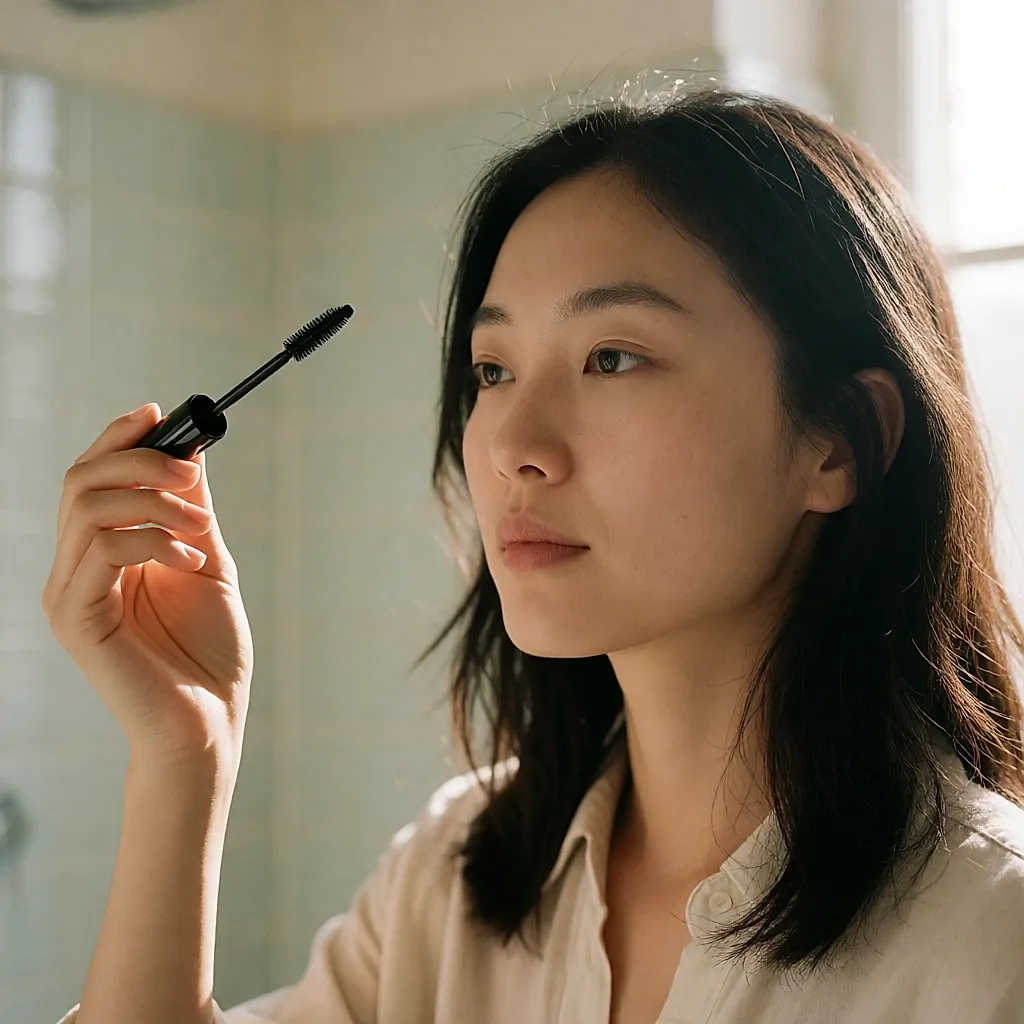
Which is why it's worth looking at the brush head through the tube on the shelf — the thing none of us ever thinks to do. Straight, fine fibres, spaced far enough apart, deliver definition and lash-by-lash separation: ideal if your lashes are short, straight, or you hate the spider-leg effect at 8am. Fatter heads — hourglass or barrel — go for volume: more product, more risk of clumps, and a stroke that is necessarily slower. As for moulded silicone wands, they comb neatly but cushion the lash less: decide whether you want a comb or a pillow.
Straight, curved, tapered: every shape has its stroke
A curved wand — the famous banana — isn't a packaging whim: its curve follows the movement of your hand when you want to lift the lash, and the concave side catches the middle lashes. It works well on lashes that hang straight down, the ones you can never get to lift. The stroke that goes with it? Place the head at the root, sweep up with light pressure, and don't go back over it.

Diameter, meanwhile, does the heavy lifting. A thick head loads, a thin head defines. A very fine wand is your ally for lower lashes and inner corners, where everything overflows and you end up with a black dot under your eye at 3pm. And if you only own one tube, a slightly tapered wand — wide at the base, narrow at the tip — is the honest compromise: volume at the root, precision at the end.
The stroke, in every case, comes down to millimetres: a zigzag at the root, then a spiral up to the tip. That's the movement that separates — not the number of coats!
So when do you choose the formula?
Once the shape is settled, the formula reads differently. Waxes, pigments, film-forming polymers: it's the formulation that delivers the wear, the deep black, the flexibility or the stiffness. A texture heavy in waxes on a dense wand and you harvest clumps. The same on an airy wand and everything breathes. It's the match between the two that counts, not the promise printed in big letters on the carton.
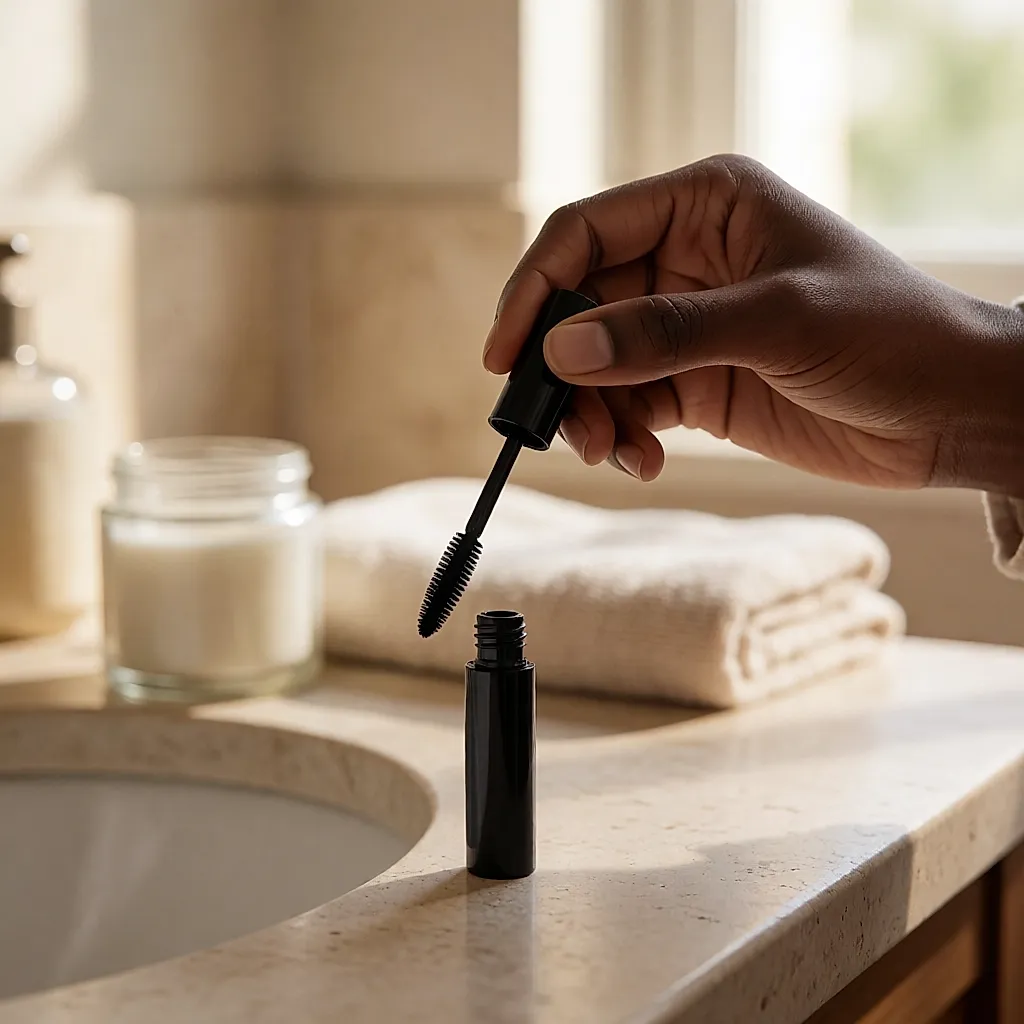
"Water-resistant" has another effect, often forgotten: it tends to set faster, so it fixes the lash wherever you left it — a bonus for curl, less room to correct a mistake. And a tube dries out in air. Wipe the stem on the rim of the tube rather than pumping it like a maniac: you'll keep a supple texture for longer. In practice most of us replace a mascara every three months — that's a handy marker, not a rule set in stone.
What it costs
On price, the spread is wide and the wand doesn't always follow it. Expect roughly £5–12 at a supermarket or health-and-beauty retailer for a perfectly decent tube, often with a moulded head or classic fibres; £12–25 at a beauty counter for more elaborate shapes and softer textures; beyond £25 you're also paying for packaging, scent and the name on it — not necessarily the stroke.
Where to buy? Supermarkets and high-street chemists are hard to beat for trying a shape without spending much; a beauty counter lets you look at the actual brush head and ask for a try-on on the back of your hand; online, be wary — photos smooth the fibres until they're invisible. On the eco side, a handful of brands offer refills or glass tubes, but it's still a minority: a refillable case is only worth it if it's genuinely refilled or taken back.
Before you buy, gently shake the closed tube, then look at the brush head in the light: if the fibres are stuck together in a block, the texture is thick. On the back of your hand, the promise reads in a second. A clean, separated stroke is a good sign; a clumpy one tells you how next Monday morning will end.
Honestly, I couldn't tell you which shape is "the best" — there isn't one. There's yours: your lashes, your hand, your patience at 7.45am. Next time, turn the tube over and look at the wand before the price tag. Trust me, it'll do the job.


Comments
Your opinion matters: rate the article, react and reply to comments.
Comments are moderated; AI-assisted comments are flagged. Text emoticons (8-), :-), <3…) are automatically shown as images.