

You get home from work, put your bag down, and your calves remind you they exist. That feeling of swollen, heavy legs, as if you were dragging two invisible weights, is not something you simply have to put up with.
Heat, long days on your feet, hours sitting at a screen and smoking all take their toll on your venous return. The good news: a few simple habits, repeated consistently, can make a real difference.
Move: the habit that changes everything
A healthy leg is, first and foremost, a moving leg. Why does it matter so much? Because the calf works like a pump, sending blood back upwards. When it stops moving, blood pools and heaviness sets in. There is nothing mysterious about it.

There's no need to join a gym. Doctors generally recommend half an hour of brisk walking a day. The rest is everyday ingenuity: stairs instead of the lift, cycling for short journeys, a few lengths in the pool when you can. Every flight of stairs counts!
Stopping smoking: what it can change
Let's be honest: you've heard it before. Smoking damages the vessel walls and slows circulation; that's mechanical. What's more interesting is what happens afterwards: studies have observed improvements in vascular function in the months after quitting. Another reason, and not the least of them.
Compression: not glamorous, but effective
Honestly, we're a long way from the hospital stockings of twenty years ago. Compression socks and tights now come in fine, coloured, almost invisible versions, even sporty ones. Have I tested them over long full days? No, and I'd rather tell you that than invent an experience. What I can say is that compression clearly eases discomfort when you're standing or sitting for eight hours at a stretch.

In practice, in the UK, compression hosiery can be prescribed by your GP; whether you pay depends on where you live and your circumstances — worth asking about. Then there's the question of heat, and no one has yet found the perfect solution.
Clothing and shoes: the details that matter
Tight belts, compressive jeans, socks that leave a mark: anything that presses on your waist or ankle can slow venous return. As for shoes, a moderate heel is generally recommended, around 3 to 4 cm. Neither stilettos nor completely flat soles.
Herbs and cooling effects
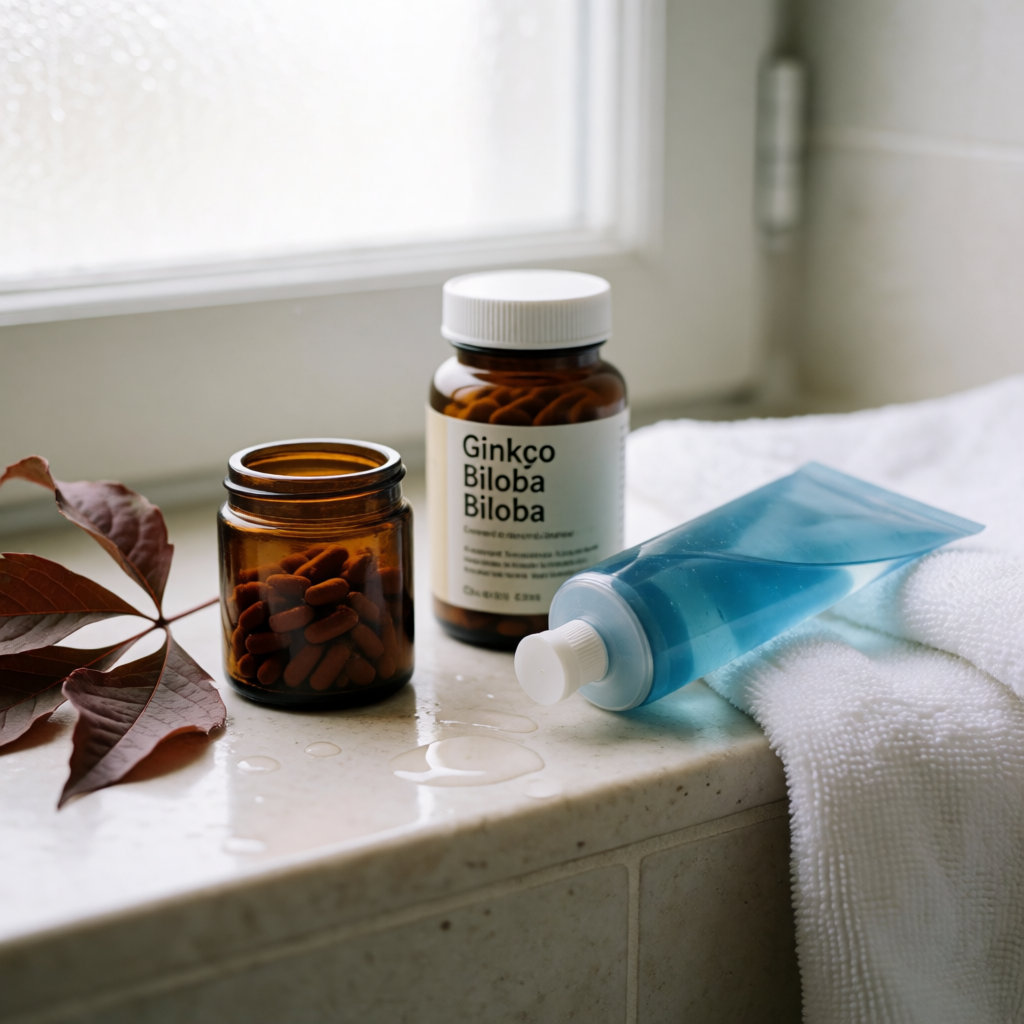
Red vine leaf, ginkgo biloba: these two herbs have long been used for circulation and are sold in capsules. Their effect has been studied, but it is modest, and these supplements are not available on prescription. Worth considering depending on your budget, without expecting too much.
Cooling gels and sprays should be massaged from the ankles upwards towards the thighs, never the other way. Immediate freshness, legs that feel like they can breathe... and relief that fades fairly quickly, it's worth knowing. The habit that changes everything in summer costs nothing: finish your shower with a cold jet, moving slowly up from your ankles to your stomach.
Three evening habits, in this order if you can: legs raised on a cushion for ten minutes, massage from ankles towards thighs with your usual moisturiser, then a cold jet on your calves. Nothing spectacular, but repetition does the work!
Massage and raising your legs
Massage, then. When you apply your moisturiser, take an extra thirty seconds to work upwards from ankles to thighs with a little pressure. It helps drainage and relaxes as much as it stimulates. Salons also offer so-called 'light legs' massages: a real treat to enjoy now and then, if your budget allows.
At night, slip a pillow under the mattress at the foot of the bed, or place a cushion at the end of the sofa. Raising your legs costs nothing and often brings relief at the end of the day.
Budget
In the UK, expect to pay around £12 to £40 for a pair of fine compression socks or tights from a pharmacy, more for fashion or sports styles; with a prescription from your GP, you may be able to get them on the NHS, depending on where you live and your circumstances. Red vine leaf or ginkgo supplements often cost between £8 and £25 per bottle, from pharmacies, health shops or online. 'Lighter legs' gels and sprays range from £5 to £20 in supermarkets or pharmacies.
A salon massage: £40 to £90 for a 30- to 60-minute session, with real variation depending on the city, salon and length.
On the natural side, look for a short ingredient list and glass or refillable packaging. But don't count on a gel to replace walking: it's a comfort, not a treatment.
When to see a doctor
If your legs are repeatedly heavy and painful, or if you notice spider veins or varicose veins, don't delay. Your GP can refer you to a vascular specialist to examine your circulation. The sooner, the better.
Sources
- NHS — nhs.uk, information on varicose veins, compression stockings and stopping smoking.
- NICE — nice.org.uk, guidance on varicose veins in the legs.
- British National Formulary — bnf.nice.org.uk, information on compression hosiery and venotonic medicines.
- World Health Organization — who.int, data on tobacco use and cardiovascular disease.
- NHS — nhs.uk, information on stopping smoking and its effects on circulation.
- National Center for Complementary and Integrative Health — nccih.nih.gov, ginkgo biloba fact sheet.
Food supplements do not replace a varied, balanced diet and a healthy lifestyle.



Comments
Your opinion matters: rate the article, react and reply to comments.
Comments are moderated; AI-assisted comments are flagged. Text emoticons (8-), :-), <3…) are automatically shown as images.