

It's one of the most misunderstood cuts in the salon. You ask for "short in the middle, long at the sides" and leave with three very different things depending on whose hand is holding the scissors. It all comes down to a couple of centimetres that nobody names out loud, and a curve that's easy to forget to describe.
Three measurements, not one
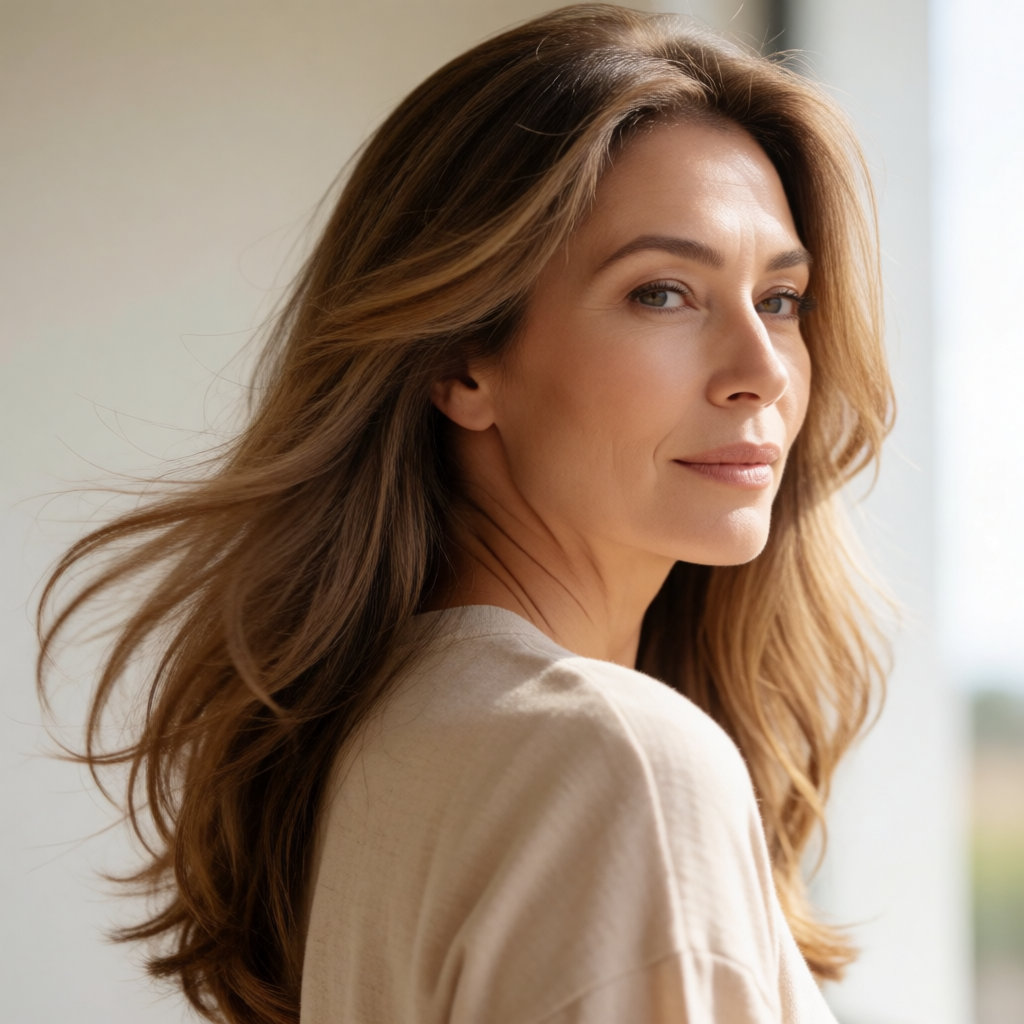
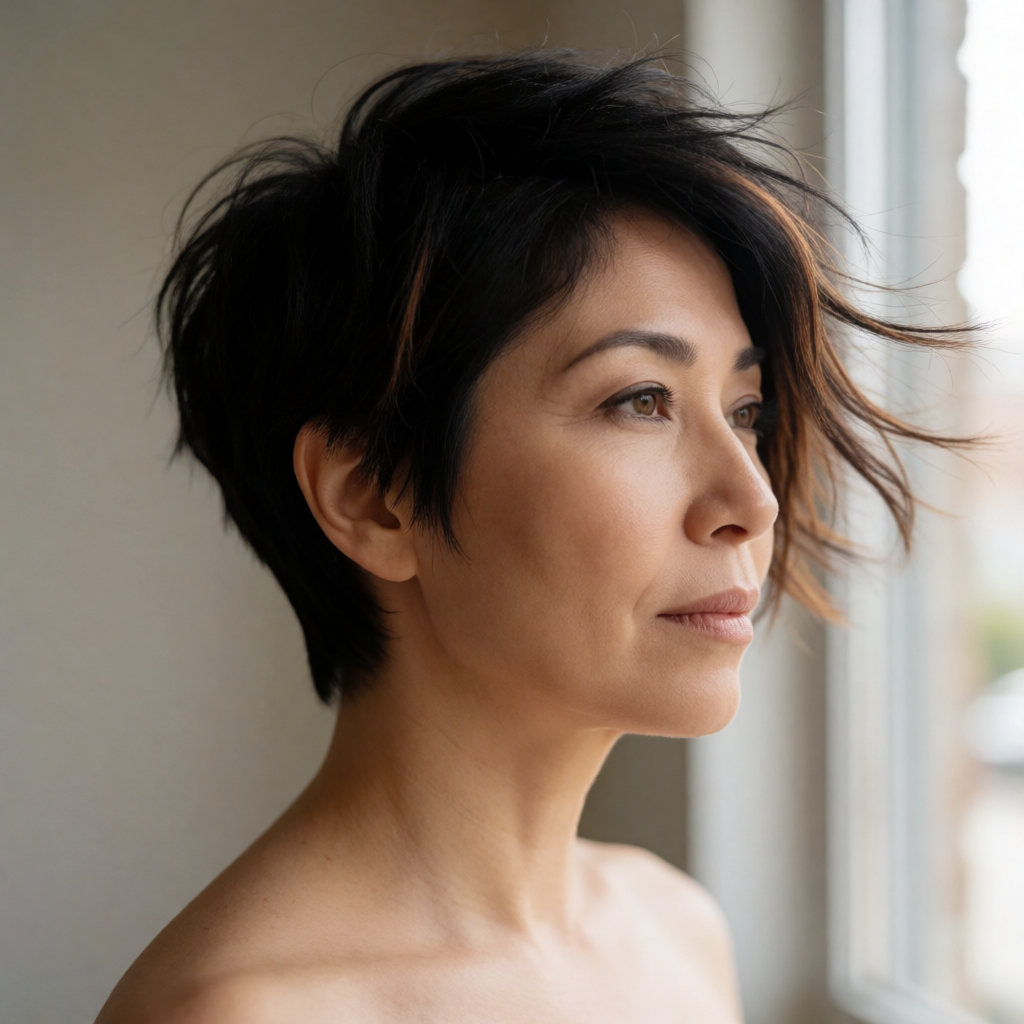
A short fringe in the centre with longer sides isn't a short fringe that's been left to grow out at the edges. It's a single line that starts on the forehead and drops towards the cheekbones. So there are three pieces of information to hand over — and in this order.

The shortest point first: in the middle of the forehead, level with the top of your brows (a finger's width higher if you want something tamer). Then the length at the temples, usually around cheekbone height — never higher than the cheekbone itself, or the hair will be back in your eye at the first gust of wind. And finally the thing stylists rarely hear: how the two join up.
This is where you need precise words. "On a curve, not a straight line." "No blunt section at the side." "I want it to drop gradually." A professional can't be expected to guess whether you're after a very soft arc or a sharper gradient, and two clients can want exactly the same thing while using opposite words. The gesture saves you: hold a section between two fingers, point to the high spot on your forehead, then to the length on your cheekbone. Two seconds, no misunderstanding.
The curve does all the work
Too much curve and you end up with a curtain fringe: lovely, but not the cut you came in for. Not enough, and the sides hang straight: helmet effect, the one you can't style by Monday morning and which ends up in a drawer with a clip.

To dodge both, ask for the cut on dry hair. Cut wet, the hair can spring up as it dries and the fringe ends up shorter than agreed — the classic surprise the day after the salon. And say something if your hair is curly: on a curly texture the section can shrink up again as it dries, so talk in terms of where it should land rather than how much comes off.
What happens between appointments
Do you really need to go back every three weeks? Not necessarily. Hair grows roughly a centimetre a month — a rough guide, not a law, and your fringe will remind you before anyone else does. In practice, plan on a trim every three to four weeks; past that, the short point becomes a curtain sweeping your eye, and you spend your mornings pushing it aside with the back of your hand.
Two options, then. The salon trim first — usually charged separately and a good deal cheaper than a full cut: ask the price before you sit down, because some salons throw it in between appointments and others don't. Then the at-home trim, with proper hairdressing scissors (not the kitchen ones, ever), and one simple rule: work section by section, almost vertically, starting in the middle. Slower, less even, and it'll do in a pinch.
When a curtain fringe is the better call
Let's be honest: this cut needs upkeep not everyone wants to pay for. If you already struggle to get a brush through your hair in the morning, if you tie it up the moment you get home, if your forehead gets oily quickly and your fringe sticks to it before lunch — the short version will cost you more effort than it gives back.
In that case, a curtain fringe is the right decision: two sections left to do their thing, pushed aside with a flick of the hand or tucked behind an ear, and forgiving of a three-week delay. Same family of cut, minus the standing appointment. It isn't a consolation prize; it's a choice.
Budget
Expect roughly £30 to £70 for a salon cut with a fringe, depending on the city and the level of the salon. A fringe trim on its own tends to sit between £5 and £15, sometimes free between cuts — worth asking upfront. For at-home trimming, a decent pair of hairdressing scissors costs £15 to £30 from a chemist or a haberdashery, and you'll keep them for years. Wherever you go, take two or three pictures: front-on, in profile, hair dry.
The sentence to copy: "Shortest point in the middle of the forehead, level with the top of my brows; temples at cheekbone height; and a soft curve between the two, no straight section." Add your two lengths in centimetres if you know them, and point to it all with your fingers.
The rest is conversation. A stylist who asks the question twice before cutting is worth more than one who got it in three seconds. And if you leave with a fringe a touch shorter than planned, breathe: it'll have grown a little in three weeks. That's the one perk of hair that grows — it never stays cross with you for long.

Comments
Your opinion matters: rate the article, react and reply to comments.
Comments are moderated; AI-assisted comments are flagged. Text emoticons (8-), :-), <3…) are automatically shown as images.