
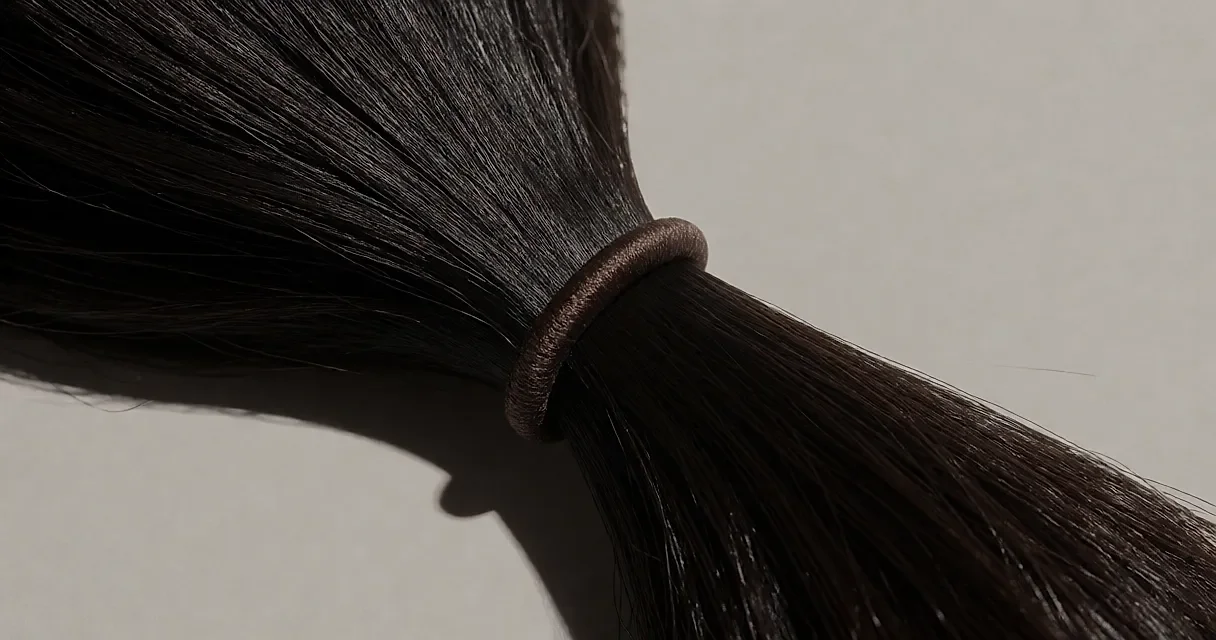
The stiff spot on a hair bobble comes down to almost nothing. It's a small, rough lump where the two ends of the band were melted together, and unlike the rest of the ring it doesn't give. It's what you feel under your fingers when you pull out a ponytail without looking, and it's what leaves the groove in your hair. Where you tie the band changes which section takes the strain, but that isn't the whole story: a bump like that can work away at the same patch every time, and both the tension and the direction of the pull are worth spreading around. So why not start by changing the accessory, rather than the hairstyle?
The pebble in the shoe
A standard bobble is a stretchy core wrapped in textile. To close the loop, the two ends are usually joined with heat: the fused join hardens the material slightly and makes that familiar bump that snags. On an otherwise flexible ring it's the only rigid point — the only place where pressure can't spread around the circumference.
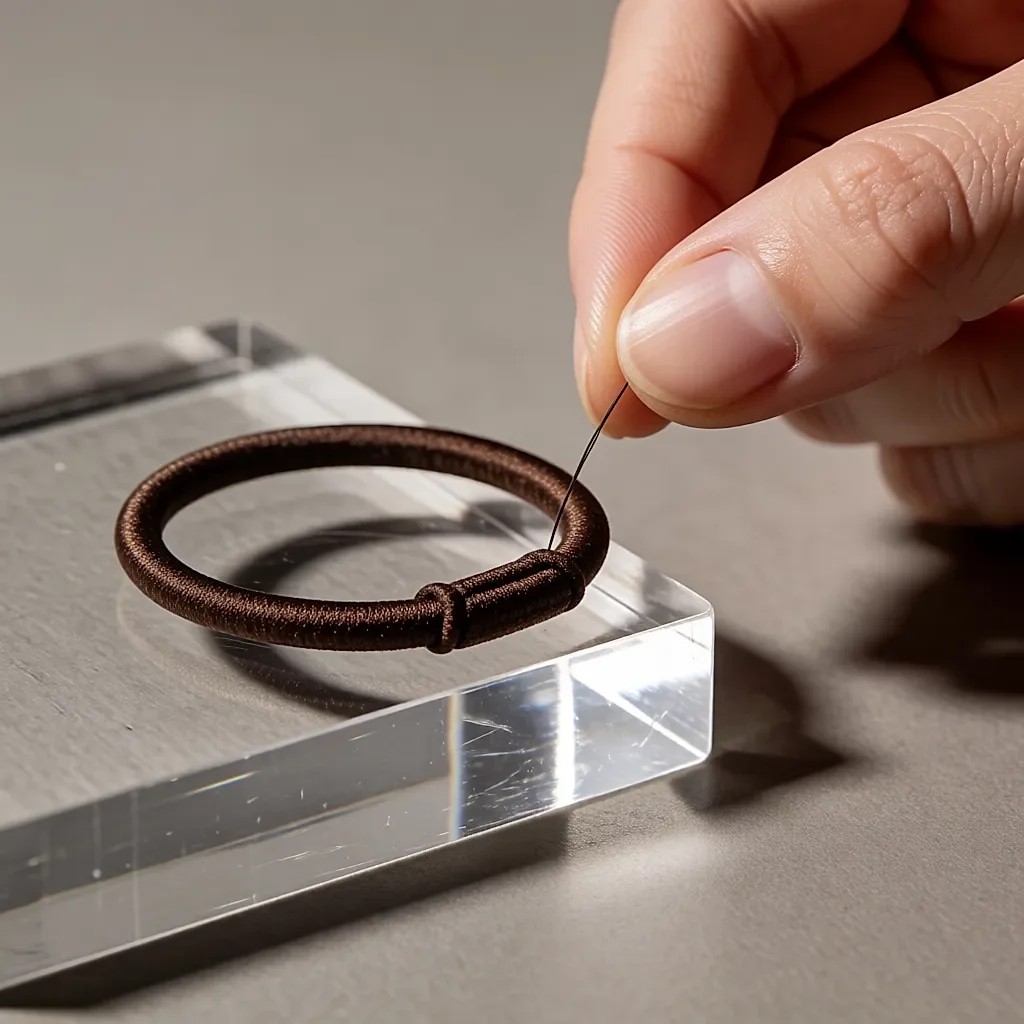
So when you tighten it, the pressure doesn't even out. The tension gathers at a single point, and that point is the least soft bit of the whole band. Hair gets pinched, bent and dented there, and comes out with a right-angled bend — the little kink you see on the strand when you let the ponytail down. There's no honest figure for how many repetitions it takes before hair starts to weaken, but clamping the same spot over and over is not a great plan; it's like reopening a book at the same page every time.
High or low, tension and pull still count
High ponytails were long blamed for being pulled too tight, worn too often, too much of everything. The reality? A low ponytail held with the same fused bobble can concentrate the pressure on the hard point just as easily, a few centimetres further down. Height changes the line of your face and how much air your nape gets; it also moves the area taking the strain, and the tension and direction of the pull still need sharing out.
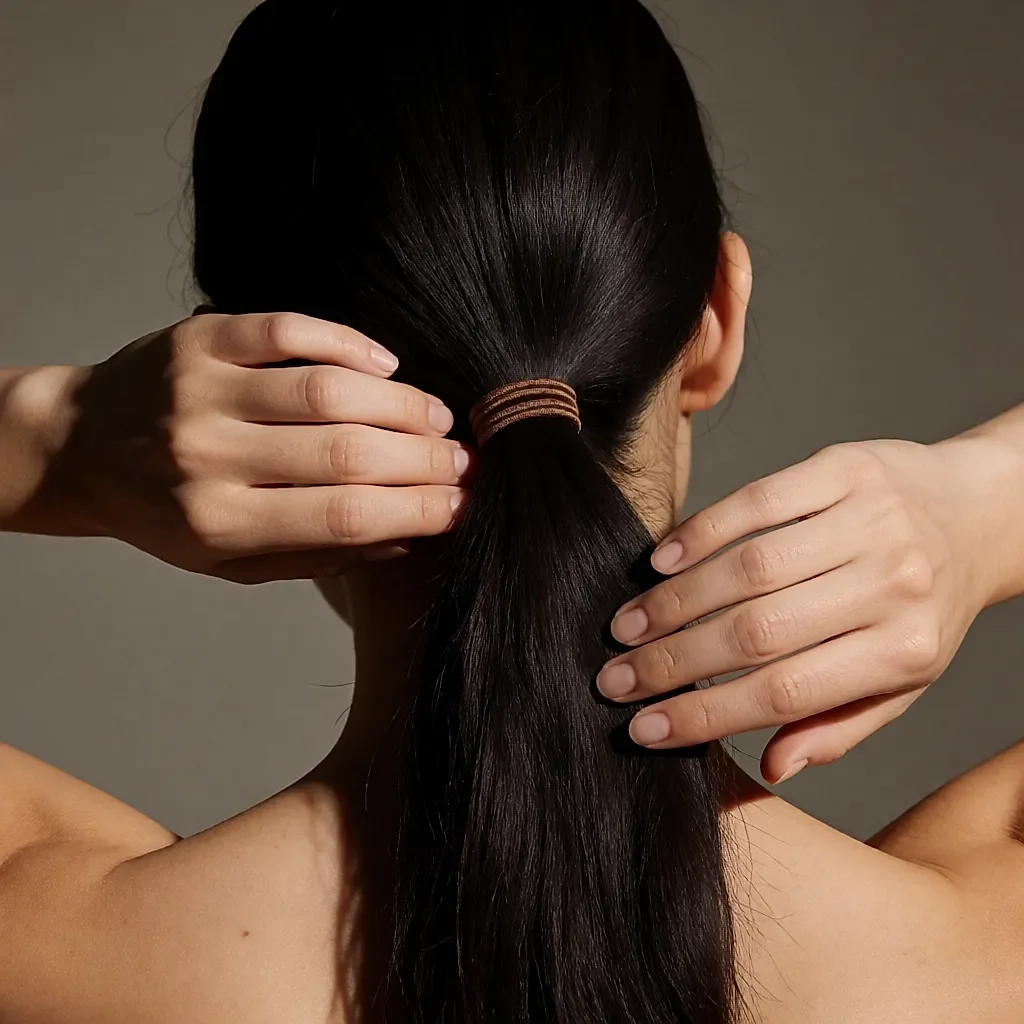
Twists matter too. Four turns around fine hair means extra pressure for the same job; an oversized bobble that you twist to compensate does exactly the same damage. In practice two turns are often enough: if the band slips, change the design rather than tightening it. A ponytail held by force isn't a ponytail that holds well, it's one that holds hard.
Three designs with no hard spot
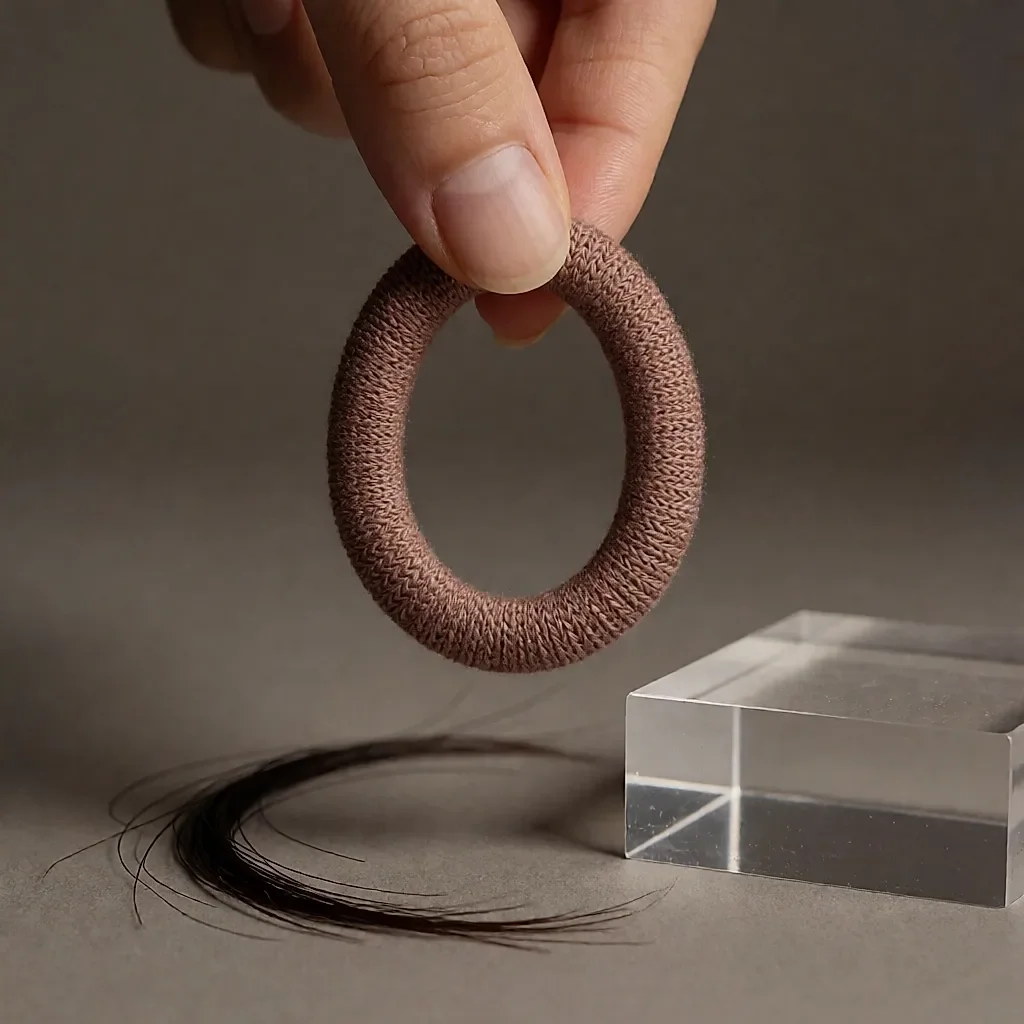
Seamless knitted rings are the most direct answer to the problem: no fused join, no metal clamp, no stiff seam — just a jersey tube that stretches evenly all the way round. No join, no hard spot, and it's daft how much difference it makes to the whole gesture. They come in cotton, sometimes in very fine merino, and suit fine hair as well as thick — as long as you pick the right size. Too loose and it slips; too tight and you're back to the problem you were trying to escape.
A scrunchie is the same principle with extra bulk. In organic cotton or silk it wraps around the ponytail instead of compressing it, so the pressure is spread over a few centimetres rather than a pinhead. Its limit, in all honesty: silk slips, and a scrunchie holds less well on fine hair. For a workout, a wide flat tie — an elastic ribbon a few centimetres across, soft, with no hard seam — is still a good compromise.
A wide tie needs to sit flat: wind it on keeping the fabric open, and don't twist it into a cord. A twist concentrates pressure on one strand, which is exactly what you were trying to avoid. Two flat passes beat four tight turns.
Taking it out, the bit we all rush
We spend ten minutes getting the style right and three seconds taking it out. Yet that's where it's decided: sliding the ring down, strand by strand, costs a few seconds more and avoids ploughing through the length. Ease it out, don't pull. That's not hair poetry, it's plain mechanics: what's resisting is the knot of hair, not the band.
Another habit worth forming: move the anchor point. A ponytail in exactly the same place every day creates a patch that takes more than its share; a notch higher, a notch lower, one side and then the other, and the strain travels. And loosen it for the night: friction against the pillowcase probably doesn't help, and nobody is judging your hair at three in the morning.
The low-stress hair tie checklist
- A one-piece ring, with no fused join and no metal clamp.
- The right size: two turns, not four.
- A tie worn flat, never twisted into a cord.
- Taking it out by hand, sliding it down.
What it costs
On the money front, it stays gentle. Expect a few pounds for a basic knitted ring, and more for silk, linen or a branded piece: you're in accessory territory, not salon treatment territory. Prices vary with the material (cotton, silk, linen), the brand and the stockist, but these are simple accessories, sold in supermarkets, chemists, haberdashery shops and online.
The cheapest option is still the scissors: an old cotton T-shirt, three strips, a knot, and you have a wide tie that costs nothing and reuses instead of buying new. The trade-off is looks — a homemade knot has real charm, it just won't pass for a wedding-updo tie.
None of this needs a salon budget or a ten-step routine. A ring with no hard point, the right size, two turns, taking it out by hand: four details that never show in a photo and that you feel the next day. Next time you tie your hair up, turn the bobble over between your fingers before you put it in — it's usually the thing that decides everything.



Comments
Your opinion matters: rate the article, react and reply to comments.
Comments are moderated; AI-assisted comments are flagged. Text emoticons (8-), :-), <3…) are automatically shown as images.