

Foot care
You spend twenty minutes on your face, adjust your hair mask to the season, and your feet? Forgotten until the first sandal day. By April, the verdict: heels that snag tights, skin like cardboard, dull nails. Does that mean booking a salon appointment? No. Twice a week, ten to fifteen minutes, and a regular routine are enough to get things back on track.
The soak: the foundation of the routine
Twice a week, a bowl of lukewarm water — never scalding. Water that is too hot can dry out the skin; if you have circulatory problems or heavy legs, seek medical advice. Allow ten to fifteen minutes: that is how long hard skin needs to soften, and therefore for the exfoliation that follows to actually do something.
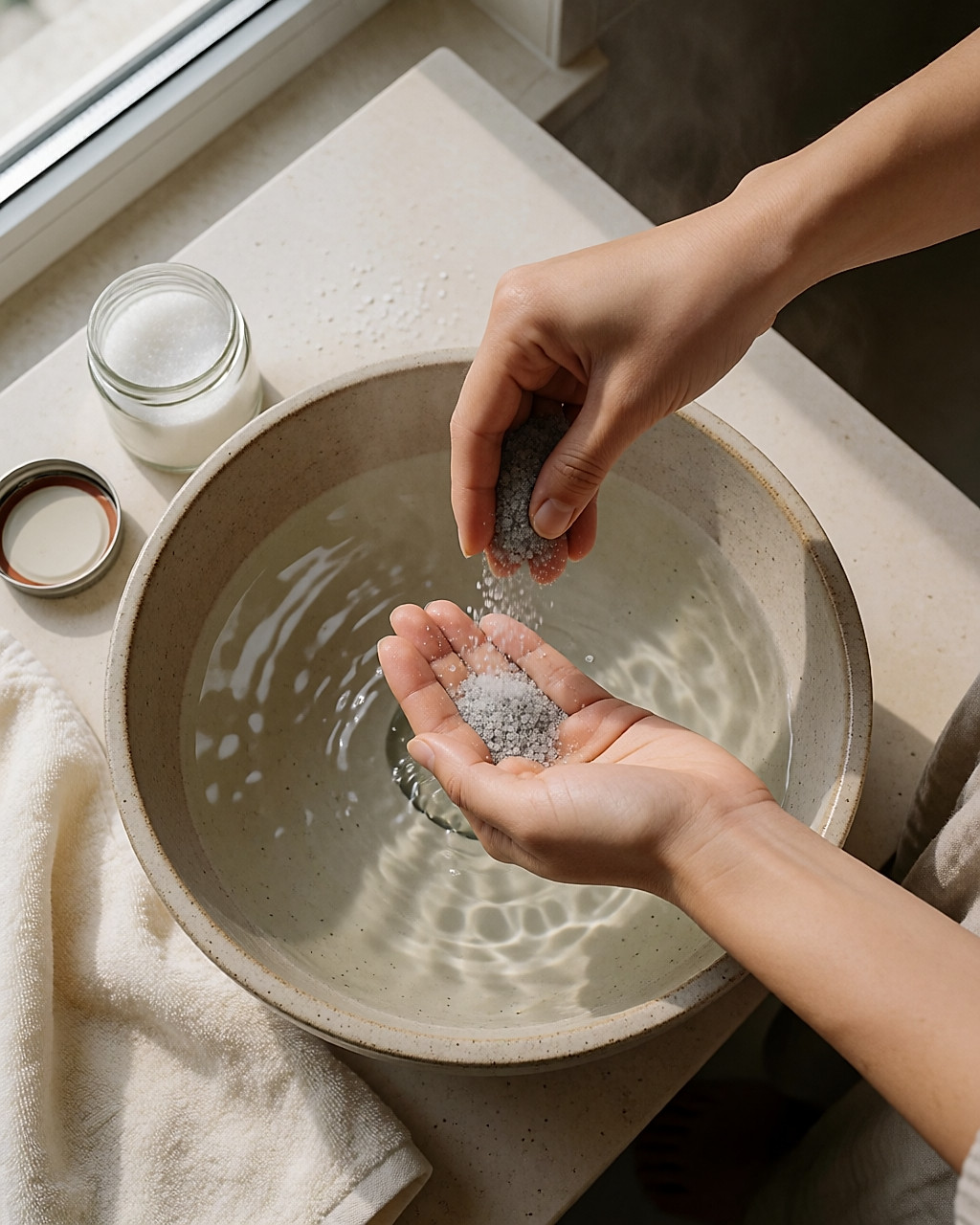
A handful of Epsom salts or coarse salt does the job, no need to look further. If you add essential oils, first check they suit you: several are not advised during pregnancy or for young children. This is not a small detail, and we would rather repeat it.
Exfoliating without turning your heel into a washboard
While your foot is still damp, remove dead cells. For regular upkeep, a pumice stone or a glass file is more than enough; on a very thick heel, a stainless steel rasp saves time, provided you go gently, without scraping as if you were sanding down a door. Focus on the heel and the ball of the foot, where hard skin builds up.

In formulation terms, a scrub with a sandy texture dislodges dead skin, while urea or salicylic acid formulas are more active on established hard skin. How often you use them depends on the concentration, the formulation, your skin type and the product instructions: urea, at certain concentrations, can even be used daily, whereas other formulas call for a less frequent routine.
Rinse, dry, observe
Rinse with clean water, then dry carefully, especially between the toes — that is where moisture lingers and fungal infections take hold. Push back the cuticles with a stick, without cutting them: they protect the base of the nail.

A nail yellowed by polish? It can help to leave it polish-free for a few weeks, until the colour fades. However, a yellow, thickened nail with an uneven surface or one that is lifting suggests onychomycosis: in that case, do not try to DIY it, see a doctor or dermatologist. Diagnosis is confirmed with a sample, and treatment lasts several months. The longer you wait, the longer it takes.
Moisturise: the step that changes everything
It is the step everyone skips, and yet it is the one that limits hard skin coming back. A rich balm on the heel and sole, massaging until fully absorbed. No foot care product to hand? Your hand cream, richer than a face cream, works very well. At night, pull on cotton socks over the top: the product will sink in better overnight.
No promises of results overnight, let us be honest: consistency matters far more than the amount of product you slather on. And if you want polish, start with a base coat to limit yellowing.
For sweating, talc has given way to foot deodorant in spray or stick form, easier to slip into a bag. The real key lies elsewhere: alternate pairs, let shoes dry for twenty-four hours, choose breathable materials. For socks, depending on the weave, some materials such as cotton, merino wool or bamboo viscose are often more breathable.
Budget
For equipment, the cost stays reasonable, and the most expensive is not always the most useful. Expect to pay around £5–15 for a glass file or a pumice stone, from a pharmacy, health food shop or podiatry supply website; £10–25 for a stainless steel rasp. A foot scrub or mask costs between £5 and £20, from a supermarket, beauty retailer or health food shop. Urea balm costs between £8 and £25, from pharmacies and health and beauty retailers, and a foot deodorant between £5 and £15.
Then there is an appointment with a podiatrist (chiropodist): £30–60 depending on the treatment and region; check with your GP surgery or local NHS podiatry service about whether you might be eligible for NHS care, or with your private health insurer if you have one.
What moves the price — active ingredient concentration, distribution channel and format — matters as much as the brand. On the eco-friendly side, a balm in a glass jar or cardboard tube, a refill, or a Cosmos Organic label (which sets rules on the percentage of organic ingredients and manufacturing processes, not performance) are useful markers. In health food shops, you will also find sugar scrubs with short ingredient lists and often recyclable packaging.
Conversely, a highly concentrated urea balm sold in a pharmacy is still a conventional product: it is effective on established hard skin, but its plastic packaging and ingredient list are conventional too. That is the trade-off, between immediate effectiveness and more pared-back packaging.
The takeaway
Twice a week, ten to fifteen minutes, and your sandals will not have that effect on you in April. The real secret is nothing dramatic: you rinse, dry between the toes (no, really, between the toes), and moisturise even when you are in a hurry — ten minutes in the evening during an episode, honestly, is doable. The rest is consistency, not budget. And if a nail seems off, a quick trip to the doctor will save you months of trial and error: that is the only shortcut really worth taking.
Sources
- Assurance Maladie — Fungal infections of the skin and nails, public information pages.
- French Society of Dermatology — Nail fungal infections, patient information.
- Cosmébio and Ecocert Cosmos — Public standards for organic cosmetics labels.



Comments
Your opinion matters: rate the article, react and reply to comments.
Comments are moderated; AI-assisted comments are flagged. Text emoticons (8-), :-), <3…) are automatically shown as images.