

Cellulite: try lymphatic drainage
You're promised lighter legs, smoother skin, a silhouette that deflates. In reality, manual lymphatic drainage is mostly a precise, slow technique — and a better understanding of how your lymph actually moves. Here's what to know before booking a session, and why it isn't a massage like any other.
The lymph: a network with no pump
Your blood has the heart to keep it moving. Your lymph has nothing of the sort. This clear fluid travels thanks to your muscles as they work, your breathing and the contractions of its own vessels. It moves through a network of channels, then through lymph nodes — in the neck, armpits, crooks of the elbows, groin and abdomen — which filter and sort as it passes. It also carries the white blood cells that defend your body.
The upshot: eight hours on an office chair, and your ankles remind you of it by the evening. That's not fate, it's mechanics.

Manual lymphatic drainage: a slow technique, not a firm massage
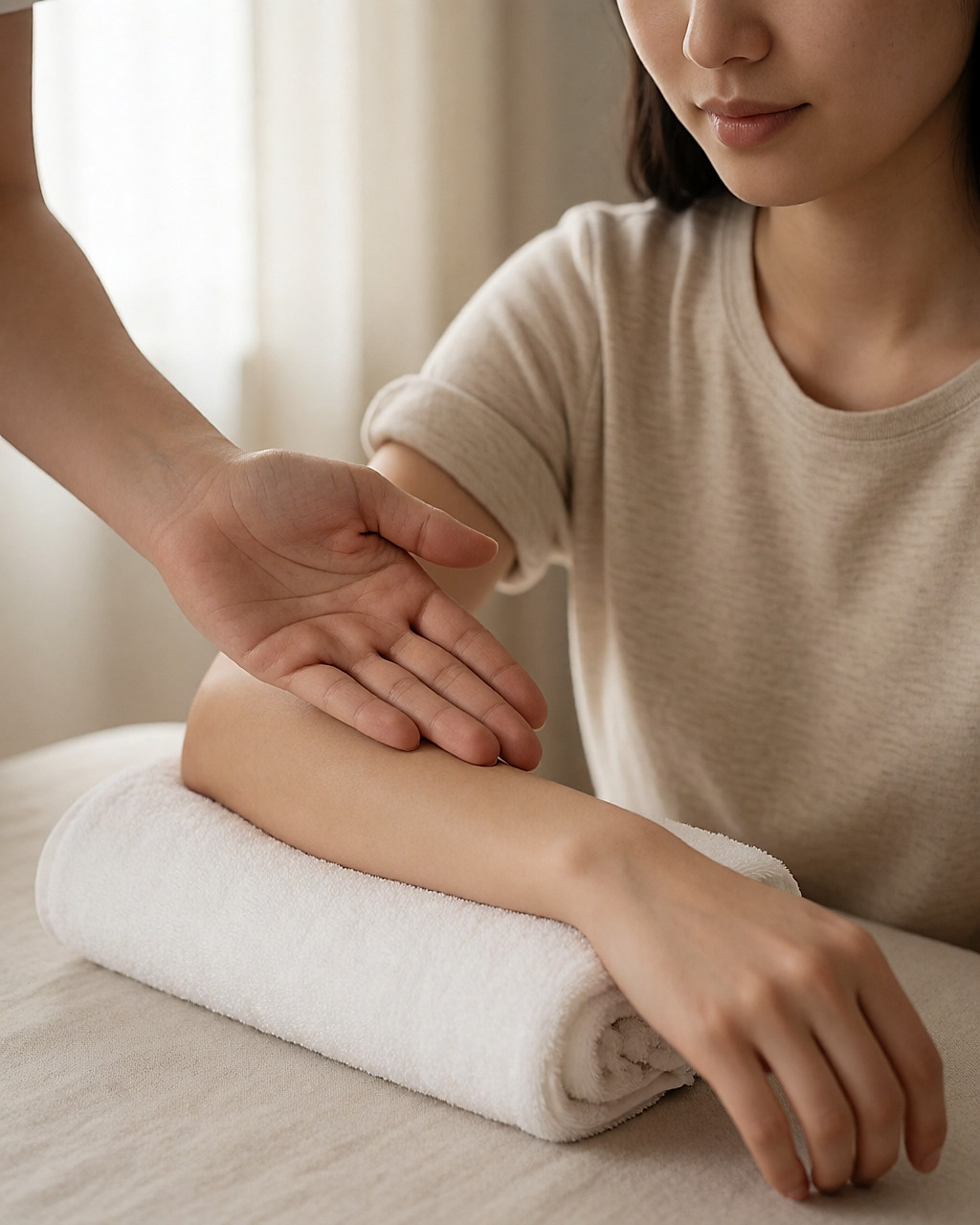
Manual lymphatic drainage is a codified method. The practitioner applies very gentle, slow pressure, always following the direction of flow, towards the lymph nodes. Allow 45 to 60 minutes per session, at a physiotherapy clinic or a specialist spa. In truth, it's nothing like a deep-tissue massage: it's precisely the lightness of the touch that does the work. If you come out aching, it wasn't drainage.
With lymphoedema, a chronic condition, drainage alone isn't enough: compression, movement and medical follow-up are what make the difference. On orange-peel skin, the evidence is still thin. No session makes cellulite disappear — and we'd rather say that up front.
Cellulite, water retention: don't mix the two up
Slightly puffy ankles after a day on your feet happen to everyone, and settle overnight. An oedema that lingers, affects only one leg, hurts or travels upwards: that's when you close the booking app and ring your GP. Lymphoedema that goes untreated gets worse and can become disabling. It isn't an aesthetic question, it's a diagnosis for a professional to make.

The everyday ritual that changes things
- Walk, swim, cycle: it's your calves that move lymph, not willpower.
- End your shower with a cool blast, ankles up towards the groin, and don't forget the back of the knee.
- Put your legs up for ten minutes in the evening rather than sitting with them crossed.
- Cut back on hidden salt: ready meals, sauces, cured meats. Sugar doesn't help either.
- Dry-brush your skin before showering, always from the bottom up.

Two things to know before you pay. Dry brushing is something I do myself: two minutes, soft bristles, never on irritated skin or over a varicose vein. Spa drainage, on the other hand, I document more than I test for you. Sessions are often sold as packages, so ask for the real length of the massage: a promised 30 minutes sometimes hides 20 minutes of hands-on work and 10 minutes of applying product.
Budget
- Manual drainage at a spa or clinic: expect around £50 to £100 for a 45–60 minute session, often sold as a package.
- With a physiotherapist: £40 to £75 privately. On the NHS, referral is usually limited to specialist lymphoedema clinics after a medical diagnosis.
- Medical compression (socks, stockings, tights): £10 to £40 a pair. Available on NHS prescription where there's a diagnosed need — free in Scotland, Wales and Northern Ireland, standard prescription charge in England.
- Dry brush: £8 to £25, with a handle in certified FSC wood and plant fibres, compostable at end of life.
- Massage oil: £10 to £20. A label such as COSMOS ORGANIC (Ecocert) certifies a formula made mostly of natural ingredients; the glass bottle is recyclable.
Brushes and oils are found in beauty halls, supermarkets and online; prices vary with city and range. Compression, though, goes through the pharmacy, prescription in hand.
Sources
- NHS — nhs.uk, pages on lymphoedema and compression.
- NICE — nice.org.uk, guidance on the use of compression.
- Cochrane Library — cochrane.org, systematic review of manual lymphatic drainage in lymphoedema (Ezzo et al.).




Comments
Your opinion matters: rate the article, react and reply to comments.
Comments are moderated; AI-assisted comments are flagged. Text emoticons (8-), :-), <3…) are automatically shown as images.