
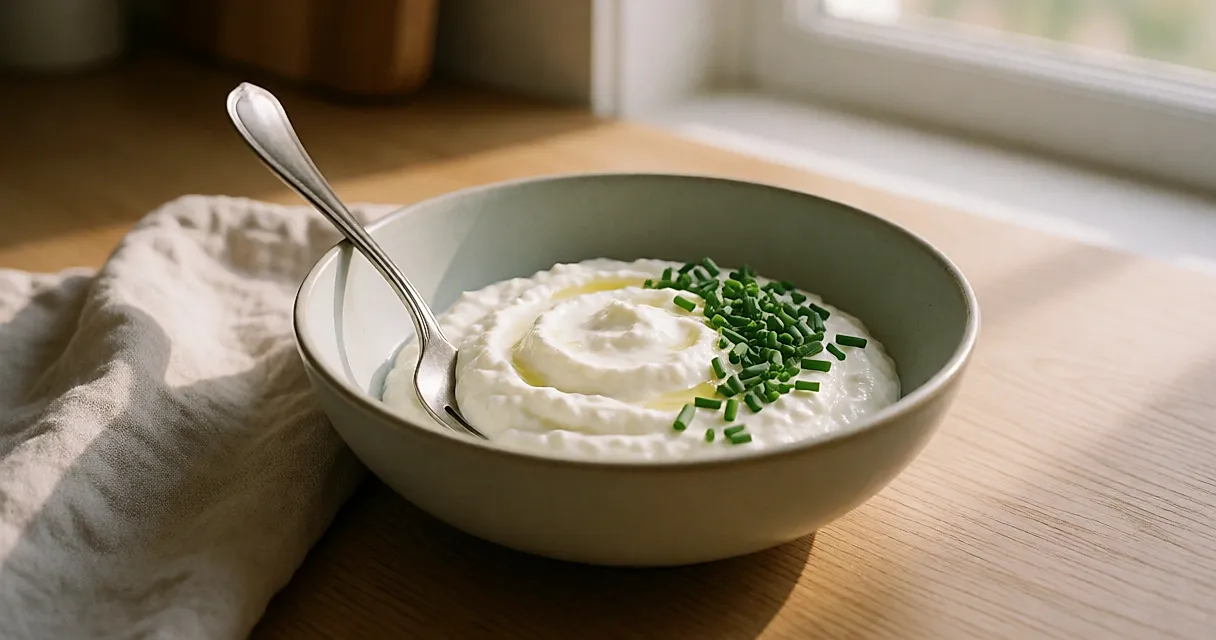
There's a precise moment when cottage cheese stops feeling like a penance: the one where a fork — or a blender — decides to break the curds. The contents of the tub go from sloppy egg white to a thick, glossy cream you can spread without a fuss. Odd, really, that a three-minute job can reset your relationship with a product most of us buy out of virtue rather than appetite.
What we know about it fits into a sentence: drained, unpressed curds with the grain left in. No industrial mystery, no secret formula. Almost everything, then, comes down to how you handle it.
Three minutes with a fork and the grain is gone
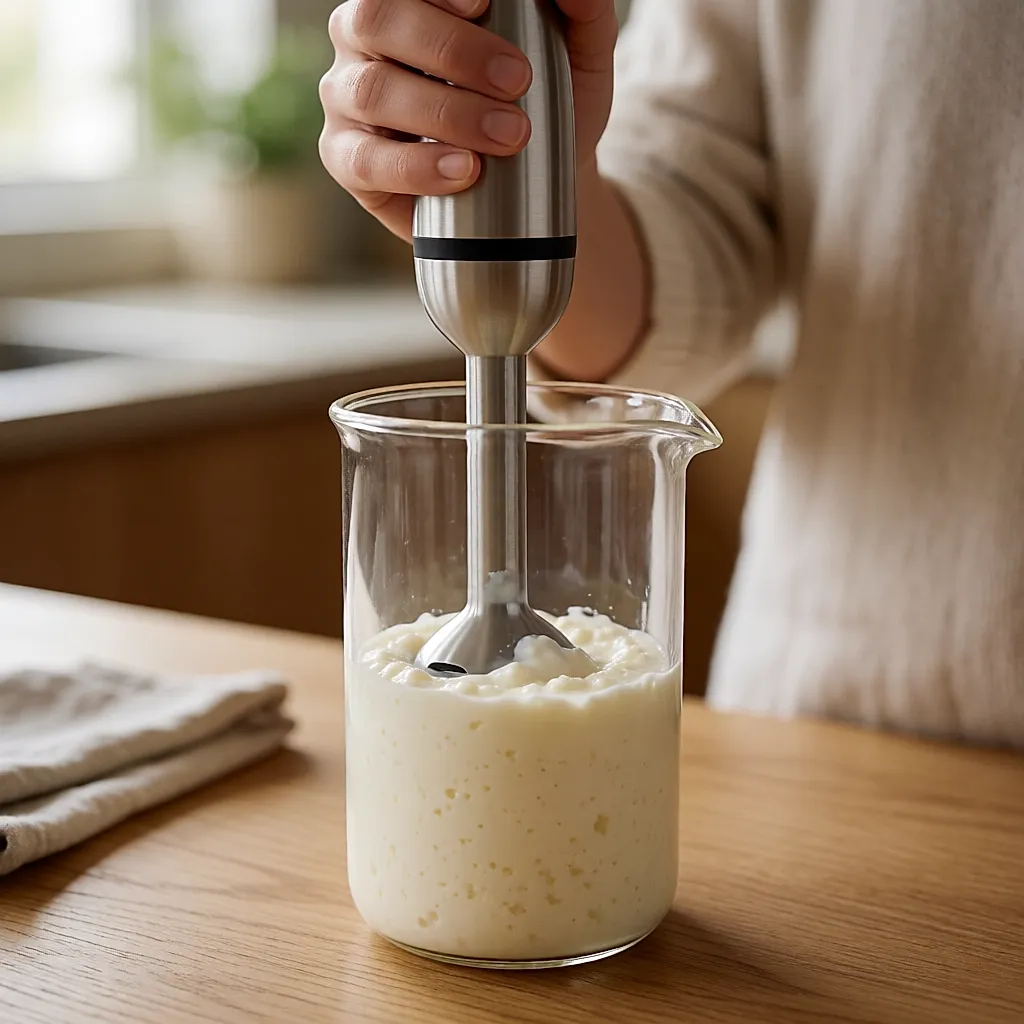
Cottage cheese is a fresh cheese sold in curds: they have been drained but neither pressed nor smoothed, and they hold on to some of the whey. Beat them and that network collapses, releasing the liquid — hence the creamy texture that appears. A brisk go with a fork is enough for toast; a whisk is quicker; a stick blender gets it smooth in 20 to 30 seconds.
The trick is not to push it. Over-blended, the mixture turns elastic and coats the roof of your mouth like a pancake batter gone wrong. Stop as soon as it starts to ripple and leave a few micro-curds in there: breaking the curds doesn't mean pulverising them. If the tub is very firm, a tablespoon of milk, water or lemon juice will loosen it — and it thickens further when cold, so go looser than you want to end up with.
Sweet or savoury, one bowl does both
On the savoury side, a whipped tub becomes a seriously practical dip base: snipped chives or dill, a drizzle of olive oil, lemon zest, black pepper, a pinch of smoked paprika. Spread on toast with sliced radishes, it is a Sunday-night supper that asks nothing of you. Loosened with a little lemon and oil, it also makes a fresh sauce for pasta — stirred in off the heat, otherwise it will split.

Sweet follows exactly the same logic: honey and berries, mashed banana and cinnamon, a spoonful of unsweetened cocoa, or a few oats left to swell overnight. The trap lies in the already-flavoured tubs, which are often sweeter than you would guess; adding your own spoonful of honey at least means you know what is going in — and lets you adjust it to the time of day and your appetite.
What the tub delivers, and what it doesn't promise
This is a fresh cheese that provides protein and some calcium, with a fat content that varies hugely between versions, from the leanest to the richest. Salt levels vary a lot from brand to brand too: a glance at the label is still worthwhile if you are watching your intake. As for quantity, it is better counted as part of the day's dairy than treated as a bonus on top of everything else.
And what we don't know deserves saying: the available evidence doesn't support claims that cottage cheese has a specific slimming effect. Its protein content can play a part in satiety, which is not the same thing as a guarantee of results. If you are on medication, have high blood pressure, kidney disease or lactose intolerance, that is a conversation for your GP or another health professional — not for the label.
The big tub or the single pots
A 500g tub of natural cottage cheese is more flexible and cheaper per kilo, but you have to finish it. Once opened, follow the date on the lid; the guidance varies between products. Keep it in the fridge, with a clean spoon, and put the lid back on properly. A little liquid gathering on top is usually whey, not a sign of spoilage; a stir is all it needs.
Flavoured single pots, meanwhile, are handy for weeks when you leave on Monday and get back on Friday to an untouched tub — and there is less washing-up. In exchange you pay for the format, the packaging and sometimes added ingredients — cream, thickeners, sugar. It is an honest compromise: less waste, higher price. And if the big tub is staring at you from the back of the fridge, it can be cooked: use it in vegetable fritters, savoury muffin batter, or a dip to serve with drinks.
Where to find it, and what it costs
Head for the chilled aisle, next to the cream cheeses, in the supermarket; you will also find it at cheesemongers and health food shops. Labels differ — plenty of tubs simply say 'natural cottage cheese', while terms such as 'creamed' or 'with cream' often signal a richer, cream-enriched mix. Read the ingredients list before you assume.
As a rough guide rather than a fixed price: own-brand natural tubs start at around £1.50 for 500g, with branded, organic or farmhouse versions closer to £3–£4 — roughly £3 to £8 per kilo. Flavoured single pots of about 150g tend to run from £1 to £1.75, and are often twice as expensive per kilo. Organic or farmhouse lines push it a step higher; where you shop and the range you choose do the rest.

For an express dip: 200g whipped cottage cheese, a tablespoon of olive oil, half a lemon, a handful of herbs, a little salt and pepper. Make it the night before if you like — it is better for it, and the tub will have begun its week's work.
If you remember one thing: buy the big natural tub, whisk it properly, and season it according to the time of day. That won't replace a varied diet, or a word with a health professional if you are following a particular diet or treatment plan — it just makes the road more enjoyable.
Comments
Your opinion matters: rate the article, react and reply to comments.
Comments are moderated; AI-assisted comments are flagged. Text emoticons (8-), :-), <3…) are automatically shown as images.