
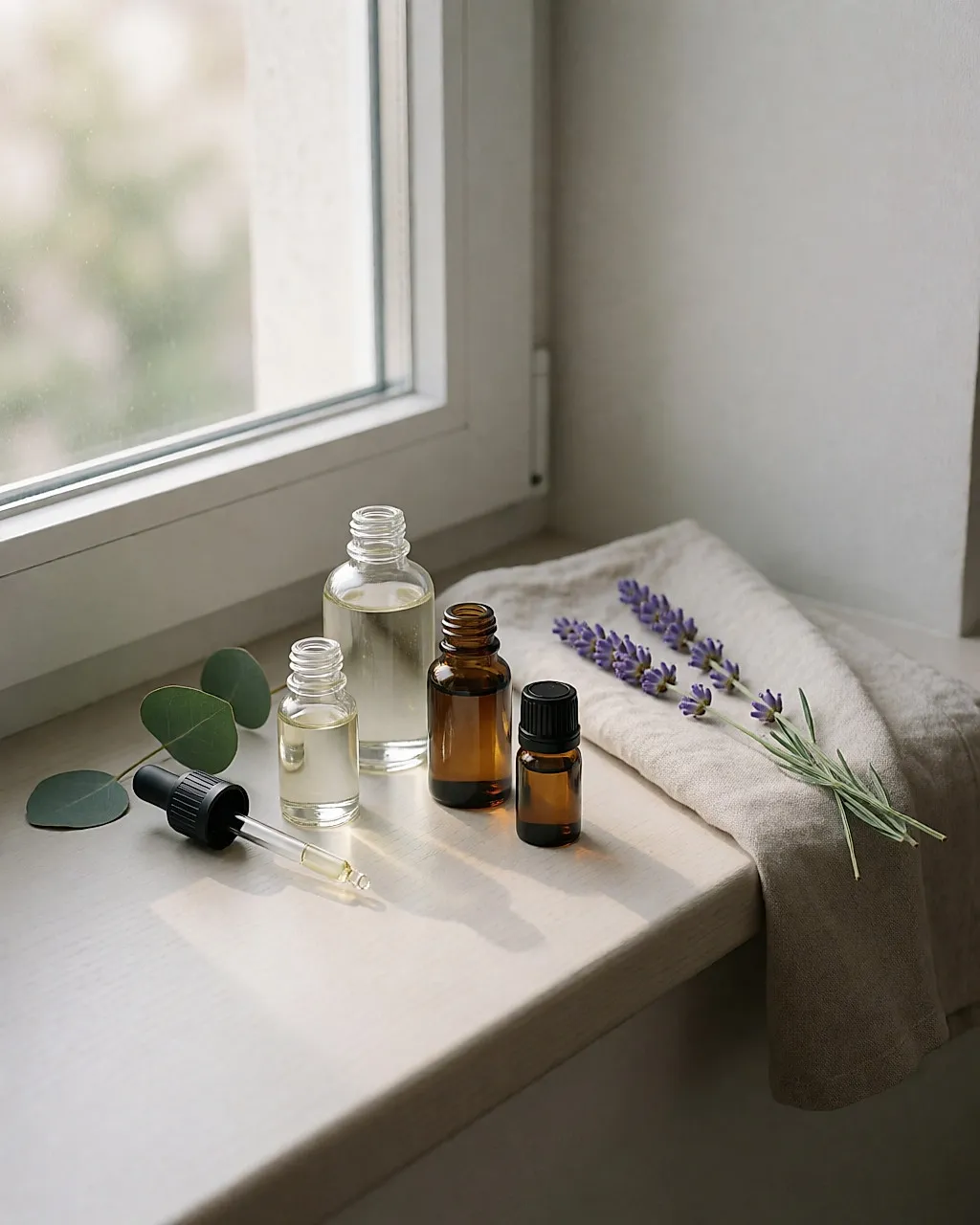
You see them everywhere: in the pharmacy aisle, in health food shops, in evening-routine videos. Essential oils have become a wellbeing reflex, almost an automatic step. What's explained less often is what they actually do and how to handle them without doing yourself harm. Here's a run-through of the main uses, and the precautions that come with them.
Three precautions that apply everywhere
An essential oil is not a carrier oil. It is a concentrated mix of aromatic molecules extracted from a plant, sometimes very active, able to cross the skin and reach the bloodstream. Two consequences follow immediately: you don't apply it neat unless you've checked that this is safe, and you don't swallow it without professional advice.
Three situations call for extra care: childhood, pregnancy or breastfeeding, and any current medication. Current evidence suggests some compounds can interact with the hormonal system. That's not a reason to panic; it's a reason to keep dose and duration under control. In practice, the pharmacy counter is still the best starting point: your pharmacist knows about interactions and contraindications.

On the skin: the massage step
For body use, start with a carrier oil — sweet almond, jojoba, sesame — which acts as the vehicle and determines how the blend feels. The essential oil is diluted into it, never the other way round. Then apply by rubbing or massaging, with slow movements, onto clean skin.

Proportions are printed on the bottle or can be checked with a pharmacist: they vary from oil to oil, and some are markedly more irritating than others. Always patch-test a small area before covering a whole arm, and stop at the first sign of heat or irritation.
In the bath: the classic trap
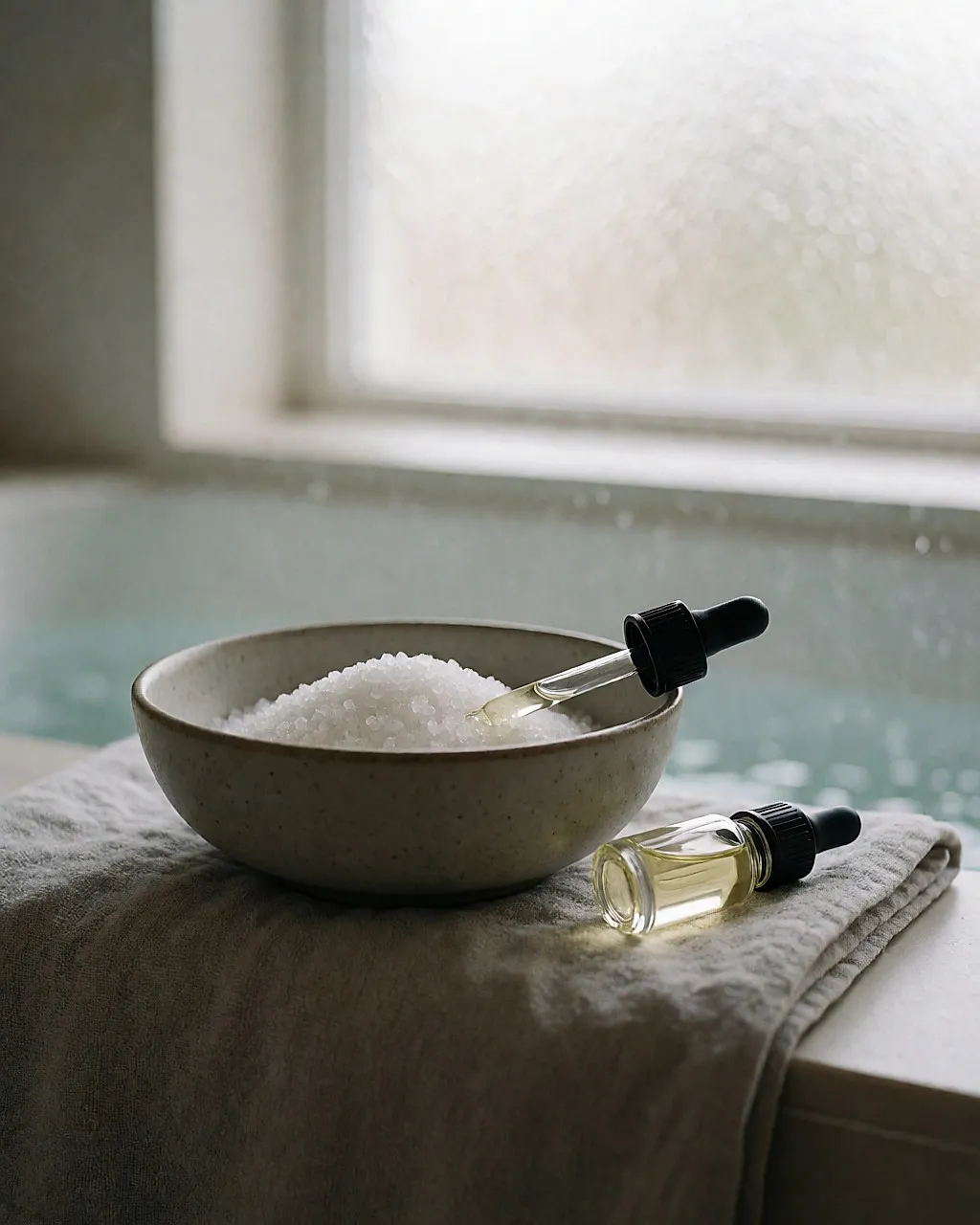
Oil and water don't mix. A drop poured straight into the bath stays on the surface and reaches the skin at an unpredictable concentration. The right method is to disperse the essential oil in a neutral foaming base, bath salts or a little powdered milk, then pour that mixture into the water.
Diffusing: yes, but not just any way
The candle burner has largely given way to ultrasonic or nebulising diffusers, which are easier to dose. Three things to watch. Air the room between sessions rather than diffusing continuously. Avoid rooms where a baby sleeps. And keep cats away: their bodies clear some terpene compounds poorly, and these are common in citrus, tea tree and eucalyptus oils — if in doubt, ask your vet.

Inhalation: to clear a blocked nose
With a cold, steam inhalation is a traditional remedy: a few drops in a bowl of hot water, a towel over the head, five minutes of breathing. Some people find it temporarily eases a blocked nose, but there is limited evidence that it helps and it does not treat the cause. Hot water can scald, so handle it carefully and keep bowls away from children. NHS advice does not recommend steam inhalation for babies or young children. If symptoms last more than a few days, seek medical advice. In young children, menthol-containing and camphor-containing products should be avoided: the risk of respiratory spasm is real and has prompted official safety warnings.

DIY cosmetics
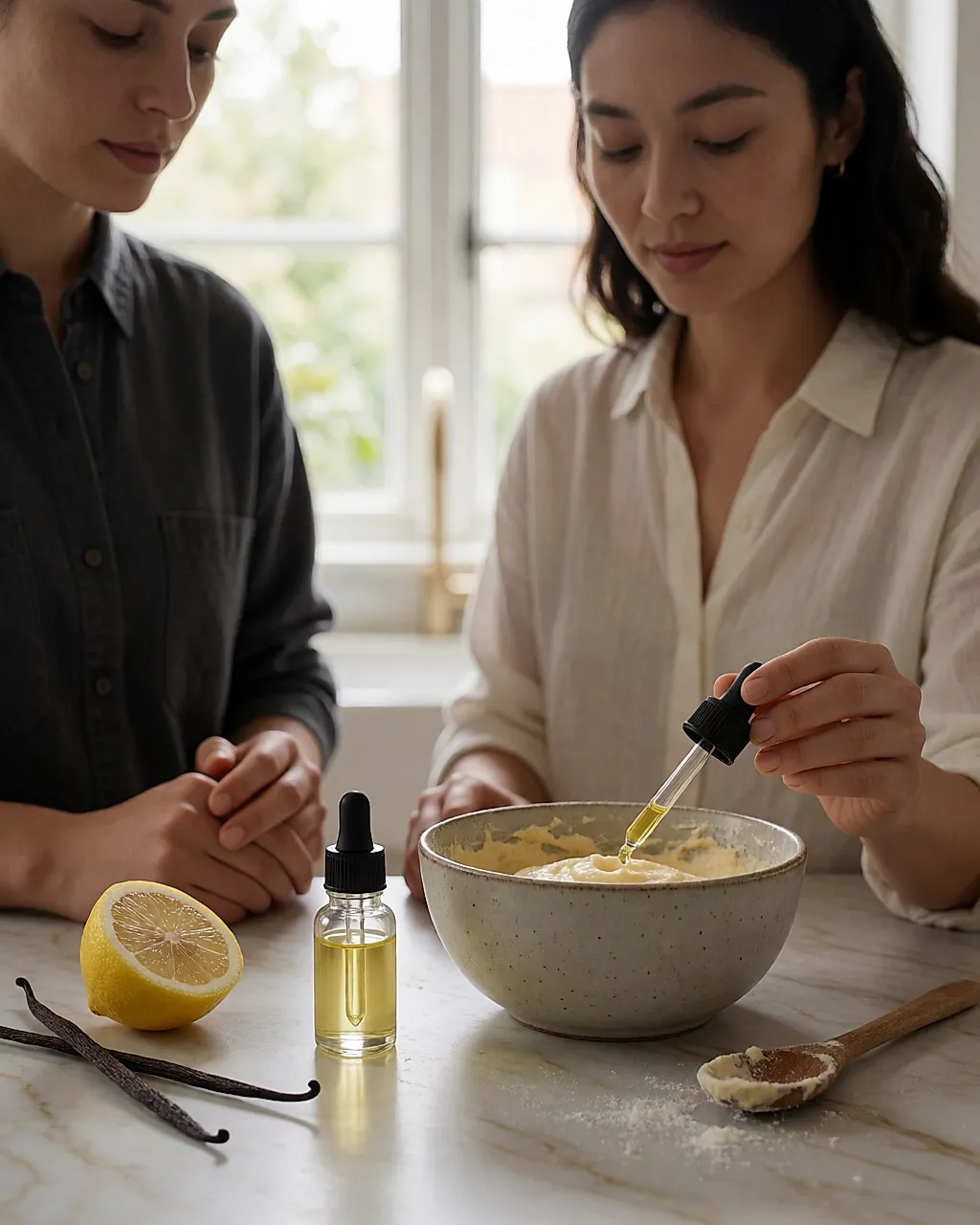
If you make your own skincare, essential oil enriches a base that is already made — a neutral cream, carrier oil or aloe gel. Watch hygiene: an open jar without preservative can quickly become a breeding ground for microbes. Clean equipment, small containers, date on the label. On the natural side, a neutral base carrying a label such as COSMOS Organic or Soil Association Organic mainly gives you a guarantee about composition and ingredient origin, not about how well your preparation will be tolerated.

In cooking: sparingly
Some essential oils are permitted as flavourings — citrus and peppermint, for example. Vanilla is not strictly an essential oil; it is usually used as an extract or absolute, so treat it separately. Essential oils are far more concentrated than fresh herbs, so one drop is enough for a dish or cake batter. Not all are suitable for food: check the label, and treat this as an occasional seasoning, not a health supplement.
What to take away
Nothing complicated — but nothing harmless either.
An essential oil should be diluted, dosed and limited in time. Contraindications depend on the oil, your age, your health status and any medicines you take. If in doubt — pregnancy, breastfeeding, a young child — speak to a healthcare professional before first use. If someone swallows essential oil accidentally, contact NHS 111 or seek urgent medical help; call 999 in an emergency.
Budget
Essential oils are sold in 5–10 ml bottles. In the UK, expect around £5–£15 for a common oil — true lavender, Eucalyptus radiata, tea tree — and £15–£30 for an organic or rarer one. The price depends on the exact botanical species, origin, cultivation method and certification (COSMOS Organic, Soil Association Organic). What pushes the bill up: the rarity of the plant, hand harvesting, small batch size.
For equipment, an ultrasonic diffuser usually costs between £20 and £60, and a base carrier oil between £8 and £20. For containers, glass remains the safe choice: it can be washed, reused and protects the contents better from light, especially if the brand offers a refill format or a single bottle without excess packaging.
Where to buy: at a pharmacy, where advice is most reliable and batches are traceable; at a health food shop or specialist retailer, with more certified choices; at a supermarket or online, often cheaper but with less verification of origin. A label covers cultivation and traceability, not precautions for use: it does not make an oil harmless.
Sources
- NHS — Common cold: symptoms and when to get help (nhs.uk)
- MHRA — Drug Safety Update: camphor and menthol products in young children (gov.uk)
- UKHSA / National Poisons Information Service — chemical and poison advice (gov.uk/ukhsa)
- General Pharmaceutical Council — standards for pharmacy professionals (pharmacyregulation.org)
- NHS — Poisoning: what to do (nhs.uk)
Food supplements do not replace a varied, balanced diet and a healthy lifestyle.

Comments
Your opinion matters: rate the article, react and reply to comments.
Comments are moderated; AI-assisted comments are flagged. Text emoticons (8-), :-), <3…) are automatically shown as images.