

A few years ago, remote working was something you negotiated as a favour. Today it's part of the landscape: software development, data analysis, writing, translation, customer service, project management, design, accounting, research — the list of roles that can be done remotely has grown, and by 2026 working away from the office no longer raises eyebrows.
But behind that flexibility lies a real need for organisation. Remote working isn't simply 'working from home': it means doing a job from a distance that could be done at your employer's premises, often alternating with days on site. Good or bad for your health? Both, really — it depends on the framework you set yourself.
A legal framework that is now clearer
In the UK, there is no single law that defines remote working. Flexible working is governed by the Employment Rights Act 1996 and ACAS guidance. Since April 2024, employees have the right to request flexible working from day one, and can make two requests a year. Employers must consider requests reasonably and decide within two months, refusing only for one of eight statutory business reasons. A written agreement or policy usually sets out location, remote days, availability, equipment and return-to-office arrangements. This isn't just admin: it prevents misunderstandings on both sides.
If you turn down a role because it involves remote working, that is your choice. If you request remote working on an eligible role and your employer refuses, they must give a business reason. Most of the time, a written document sets out the place of work, remote days, your availability, the equipment provided and how a return to the office would work. It avoids misunderstandings on both sides.

What remote working changes for your health
The first gain is obvious — or rather, it's in your legs. Fewer commutes means less fatigue, less accumulated stress, and sometimes an extra hour of sleep in the morning. In practice, many remote workers gain autonomy and organise their day better, with a fairer balance between work and personal life.
There's also an under-discussed effect: inclusion. Remote work opens doors for people with disabilities, carers, and anyone who needs particular adjustments.
But none of this is automatic. The benefits depend on your organisation, your space, and above all the quality of communication with your team. Working remotely doesn't mean working alone: video calls, informal chats and morning messages all matter for keeping a sense of belonging.

The risks not to overlook
Isolation creeps in without warning. It seeps in when the week's only contacts are technical meetings.

Sedentary behaviour is more insidious: days sitting, shortened breaks, rare movement. Over time, this can contribute to muscle tension, back pain, musculoskeletal problems and stubborn eye strain. These aren't inevitable, just effects to anticipate.
Hyperconnection also lurks. Without a clear boundary between work and rest, evening or weekend notifications keep mental load switched on. There is no standalone legal right to disconnect in the UK, but a clear out-of-hours policy is not a luxury: it helps you recover and sleep properly.
Finally, your setup directly affects comfort. A screen that's too low, an unsuitable chair, insufficient lighting: your body sends signals — listen to them.
The closing ritual: before you shut down, note the first thing to do tomorrow in two lines. You switch off more easily, and start the next day without the mental load of 'where was I?'.
Organising your day-to-day
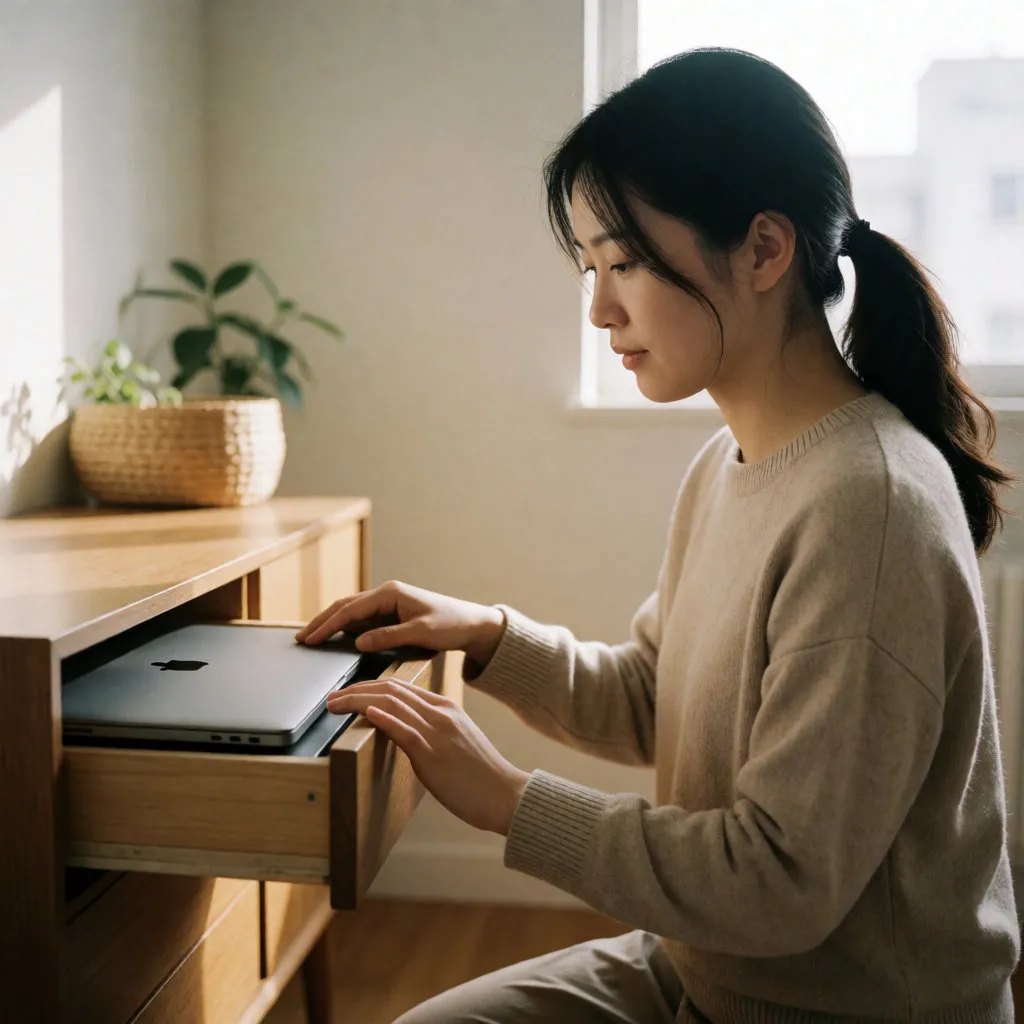
A dedicated space, even a tiny one, helps the brain associate a place with professional activity. If you live in a single room, put equipment away at the end of the day: the gesture is simple, the effect is clear.
Routines are better than iron discipline: a fixed start time, a written to-do list, laptop closed at a reasonable hour. Natural light, regular breaks and some movement offset part of the hours spent sitting.

On the collective side, digital tools don't replace rules. Availability statuses, response times, short meetings, shared documents: these practices limit constant interruptions. And for those who find solitude difficult, third places and co-working spaces offer an alternative to home, with a major advantage — physically separating work from rest.
Budget
If you choose to kit yourself out, prices vary enormously by quality, city and retailer.
- An ergonomic office chair: around £100 to £350 new from a specialist or online, and more like £40 to £180 second-hand or refurbished.
- An external monitor: £80 to £250 depending on size and resolution.
- A footrest: £15 to £50 from a general retailer or furniture website.
- A height-adjustable desk: £200 to £600, with prices rising for motorisation and stability.
- Co-working: £20 to £35 per day, and £150 to £400 per month depending on city, commitment and included services.
Good to know: in the UK, there is no blanket legal duty for employers to cover all remote-working costs, but many cover equipment or offer an allowance. Employers must still meet health and safety duties, including for display screen equipment. Ask HR before you invest — some equipment may be provided.
Negotiating and preventing problems
To request remote working, it's better to come with a balanced case: what the organisation gains, a trial period, on-site days, monitoring indicators. The request goes down better when it reassures the team.
This is also the moment to remember two points. First, your employer can monitor your activity during working time, but it must be proportionate, transparent and respect your privacy. The ICO's guidance on monitoring at work says any monitoring should be lawful and fair. Second, your employer remains responsible for your health and safety. An accident that happens during remote work may need to be reported under RIDDOR, and employers still have duties to assess risks.
Remote working is neither a perfect solution nor a constraint: it's a framework to build, test and adjust. If pain sets in or your sleep worsens, speak to a healthcare professional — and to your occupational health or HR team.
Sources
- Employment Rights Act 1996.
- ACAS, 'Flexible working' and 'Hybrid and remote working'.
- GOV.UK, 'Flexible working: request flexible working'.
- ICO, 'Monitoring at work'.
- Health and Safety Executive, 'Display screen equipment (DSE) and remote working'.



Comments
Your opinion matters: rate the article, react and reply to comments.
Comments are moderated; AI-assisted comments are flagged. Text emoticons (8-), :-), <3…) are automatically shown as images.