
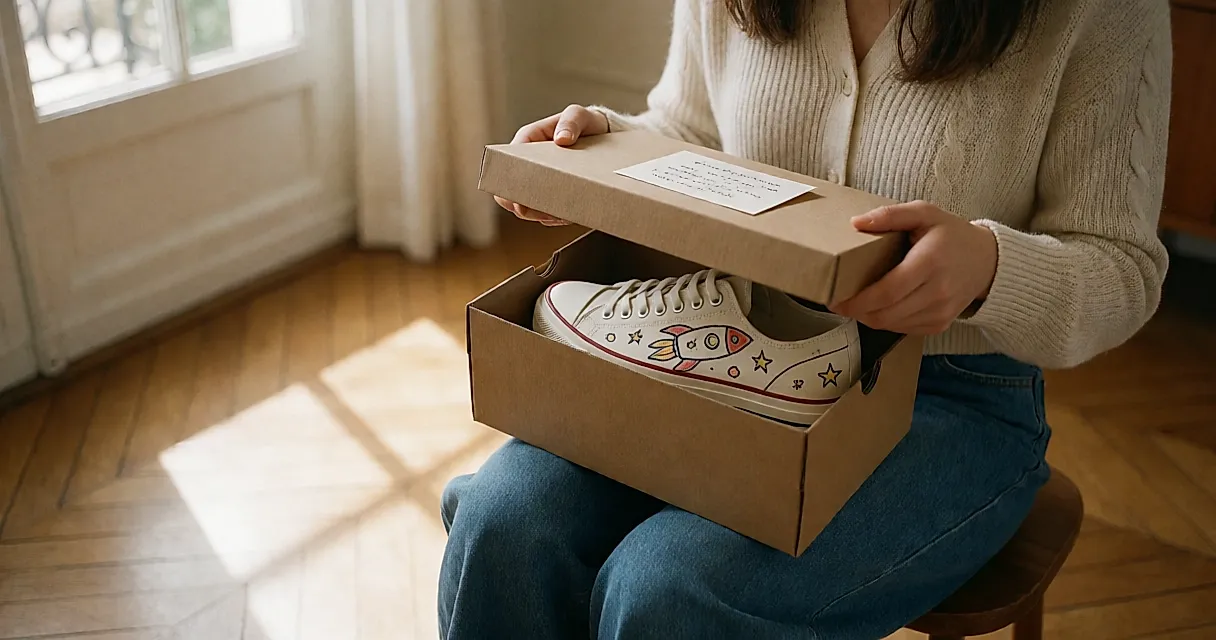
11.47pm, on the sofa, a series playing to nobody. On a resale app, there they are: “deadstock, never worn”. Inside the original box, a felt-tip drawing — the work of a child who was in hospital that day. Close the app, open it again, check you read it right.
The premise? A pair drawn by a young patient, produced as a limited run, with part of the proceeds able to be directed to the children's ward. On paper the gesture is clean, even rather lovely. So how does a gift turn into a quoted price?
A drawing, a shoebox, a donation
The charity drop is a simple mechanism, and that's exactly what makes it likeable. A child in hospital draws something; the brand takes the motif, puts it on a silhouette, prints the box, sometimes slips a note inside the lid. The run is announced for a set date, in a fixed quantity, with no restock planned. A share of the revenue goes to the hospital, and the brand can state the amount in advance.
What the buyer is paying for in that moment isn't only a pair of trainers: it's a piece of a story. You wear a child's drawing, you tell people where it came from, and the drop price stays that of a slightly special pair, depending on the brand and the finish. At that price you get the gesture and the object. Not a bad deal.
When resale gets involved
Then resale arrives. Some drops are very short; the online queues get hammered, the common sizes go first, and whoever missed out starts looking elsewhere. That's when the box changes sides. A pair bought at launch can reappear far dearer, sometimes even more so in the most in-demand sizes — every listing sets its own market.
The detail that stings: in plenty of listings the hospital isn't mentioned at all. Instead you read lines like “collaboration”, “never worn, tags intact”. The good deed has sometimes done its job as a selling point, then vanished from the description. The felt-tip drawing becomes a motif; the motif becomes a pitch; the pitch becomes a price.
Why scarcity pushes prices up
Three ingredients are enough. A quantity fixed in advance and never reissued — that's the definition of a limited run, and it's also what allows speculation. A strong story, the kind you want to tell over the Monday-morning kettle. And an audience that couldn't buy at the right moment, ready to pay to catch up.
Add the geometry of the foot: some sizes can be more sought after depending on the model. The result is pairs gaining value within weeks. None of this is scandalous or illegal — it's a market, with its rules and its reflexes. But it's worth knowing what you're looking at: you're no longer buying a child's drawing, you're buying scarcity.
What does and doesn't reach the hospital
It's the question we should all ask before clicking. The donation in this kind of operation is usually calculated on the drop's sales — a percentage of the brand's takings, or a sum announced in advance. Once the pair leaves the shop, it leaves the circuit too: resale, as a rule, raises nothing for the hospital. The seller pockets the money, the platform takes its cut, and the children's ward is left with its first cheque.
That's no reason to turn your nose up at charity drops — they can raise money, and that's already a lot. It is a reason to look at where your money is going. Buying at the drop funds the gesture. Paying more to a private seller funds someone who played it well. Both are allowed; they just aren't the same story.
Before you fall for a charity drop, three habits worth having: check on the brand's website which organisation receives the funds and on what terms; buy at drop time if you want the gesture to count; and if you come to it secondhand, treat it as an ordinary fashion purchase rather than a good deed — keeping the box and proof of purchase, which are useful both for resale and for authenticity.
Then there's real life, the part that happens once the lid comes off. A pair like this looks wrong in a hushed drawing room and very right on a rainy Sunday, with wide-leg jeans and a coat that has already lived a bit. Wear them, scuff them, stain the sole. A child's drawing on a shoe that lives by the front door — that's what makes them worth the money.
Budget
On price, it's impossible to give a figure that holds for every drop: benchmarks vary widely with the model, the size, the condition and whether the box or proof of purchase is there. As a rough guide, expect somewhere between £100 and £175 at drop time for a limited-run pair, and £210 to £510 on the resale market when demand is high — figures that don't apply to any one drop and aren't a verified survey. For the drop itself, head to the website of the brand running it; for resale, look at Vinted, eBay, Depop or StockX, and check the listing and the authenticity.


Comments
Your opinion matters: rate the article, react and reply to comments.
Comments are moderated; AI-assisted comments are flagged. Text emoticons (8-), :-), <3…) are automatically shown as images.